
We push a high-resolution camera from your cleanout to the Cincinnati MSD tap, mark every defect by depth, and hand you the footage. Same-week scheduling across Hamilton, Butler, and Warren counties. No repair quote attached. No upsell. Just honest reporting with no ulterior motive. Brandon runs the local Cincinnati team.
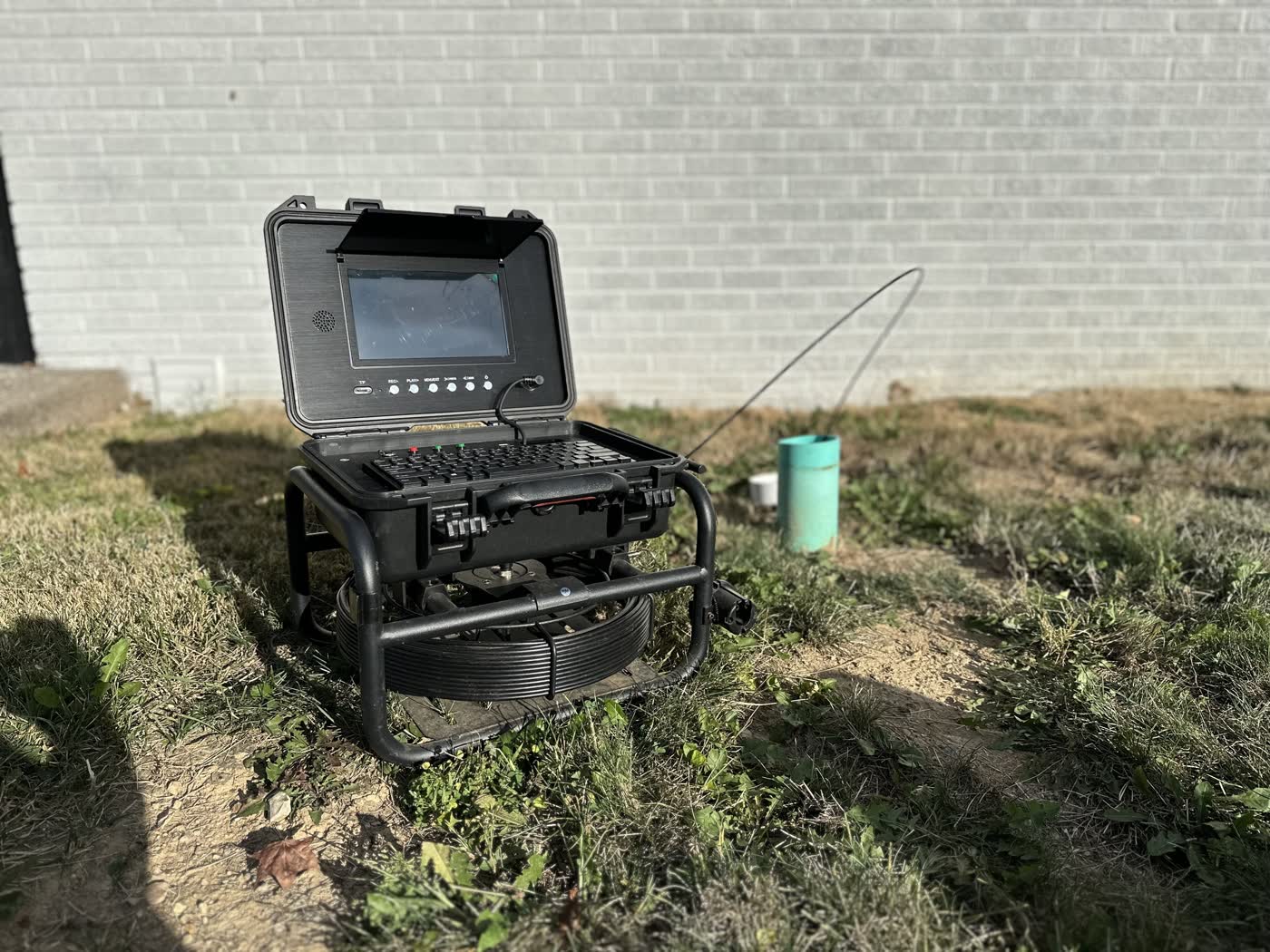
A sewer scope inspection is a video inspection of the sewer lateral line that runs from a home to the public sewer main. A small high-resolution camera on a flexible cable is pushed through the line, and the operator records footage of the interior (Rocket Mortgage).
In Hamilton County, the homeowner owns the lateral from the foundation to the connection at the Metropolitan Sewer District (MSD) main. MSD administers the public sanitary sewer system across the county. Whatever happens between the foundation and the MSD tap is on the homeowner. Greater Cincinnati Water Works runs the water-side connection separately (Cincinnati MSD, Greater Cincinnati Water Works). A scope is the only practical way to see what is between the foundation and that tap before closing.
InterNACHI classifies sewer scope as a recommended ancillary inspection for any home built before 1980, where Orangeburg or cast iron piping is statistically likely (InterNACHI). The Cincinnati pre-1980 share is meaningfully higher than the U.S. average because of the metro's nineteenth-century urban core (Over-the-Rhine, West End, Mt. Auburn), the 1900 to 1940 streetcar-era residential belts (Hyde Park, Mt. Lookout, Clifton, Westwood), and the 1920s planned community of Mariemont. For most Cincinnati housing eras, scope-on-purchase is the standard answer.
"We are not plumbers. We hand you the footage and the report. Just honest reporting, no ulterior motive." The Cincinnati team standard · Sewer Scope network
Cincinnati findings cluster around three distinct housing-stock waves, each producing a different defect pattern.
Over-the-Rhine, West End, Mt. Auburn, parts of Avondale, Walnut Hills, and the older sections of Clifton and Price Hill. Joints shifted over a century of root pressure. Heavy cast iron scale where the original pipe survives. Often no accessible cleanout (we pull a toilet to access the stack on these).
Hyde Park bungalows, Mt. Lookout, Mariemont planned community, Westwood, North Avondale, Pleasant Ridge. Cast iron lifespan is 50 to 100 years; deterioration commonly begins after 25 (Balkan Plumbing). These mains are mid-to-late life. Original clay tile laterals have seen 80 to 120 years of pressure.
Madeira, Kenwood, Anderson Township, Finneytown, parts of Springdale and Forest Park. Useful life around 50 years ideal; known failures in as little as 10 (InspectAPedia). Almost every install is past useful life today.
About seven of every ten Cincinnati jobs come in through a real-estate agent. The footage is the same. The reason it gets ordered is not.
Scope inside the inspection period. The cleanest math in the buyer packet: $200 to $300 versus a much costlier Hamilton County lateral replacement (Angi Cincinnati). Pre-1980 Cincinnati stock is statistically likely to need it.
Pre-purchase sewer scope →Scope before listing. A known condition you priced in is not the same as a deal-blowup discovered during inspection. Especially common across Hyde Park, Mt. Lookout, Mariemont, and Madeira. Disclose what is real under the Ohio Residential Property Disclosure (Ohio Revised Code 5302.30) with the camera record in hand.
Pre-sale sewer scope →Same-week scheduling is the killer feature for the CABR-member agent ordering scope #81 this year. Professional PDF, listing kit, no buyer-plumber upsell blowing up the inspection period.
Realtor partnership →Cincinnati Sewer Scope inspections start at $200. The Cincinnati market sits in the $200 to $300 band for most laterals. National averages from Angi run $1,500 to $5,000 depending on access and lateral length (Angi national cost data).
Now compare what the camera prevents in Cincinnati specifically. Hamilton County sewer line install pricing tracks the regional average closely, with most homeowners spending $1,700 to $6,300+ depending on access and length (Angi Cincinnati). Full Orangeburg lateral replacement can hit $4,000 to $15,000 depending on depth, footage, and surface restoration. Hillside neighborhoods (Mt. Adams, Clifton, Price Hill) add a grade premium for excavation access. A $200 scope is not a tax. It is the cheapest piece of information in the transaction.
You pay after the inspection. No deposit and no upfront payment. The Cincinnati cost calculator on the home page shows real Hamilton County repair ranges by defect type, depth, and length.
In Hamilton County and the City of Cincinnati, the homeowner owns the sewer lateral from the foundation to the connection at the Cincinnati Metropolitan Sewer District (MSD) main. MSD administers the public sanitary sewer system across the entire county. The homeowner pays for lateral repair, replacement, root clearing, and any tap-side repair where the lateral meets the MSD main (Cincinnati MSD).
Lateral work requires an MSD permit and a contractor that is Cincinnati-registered, insured, and bonded. Hamilton County government and the local building department coordinate permitting on the property side; MSD coordinates the tap-side connection. Greater Cincinnati Water Works runs the water-side service line separately, so a sewer-lateral repair does not automatically pull the water connection (Greater Cincinnati Water Works, Hamilton County).
None of this changes who pays. It changes the math on what the repair will cost. The scope tells you which side of the lateral has the defect, which determines who is on the hook, and which determines the bid your buyer plumber writes.
Three Cincinnati-specific tools on the home page do most of the buyer education work. Cited sources, real Hamilton County data, no fluff.
Punch in your Hamilton, Butler, or Warren county ZIP. Get the housing-stock era and the Orangeburg or cast iron risk profile for that neighborhood. Hyde Park 45208, Mt. Lookout 45208, Mariemont 45227 all classified HIGH risk. Mason 45040 and West Chester 45069 classified MODERATE, since even newer homes fail a sewer scope about 40% of the time.
Defect type, line length, lateral depth (including a hillside option for Mt. Adams / Clifton / Price Hill), optional Cincinnati MSD permit fees. Output is a real Cincinnati cost range with footnotes citing Angi Cincinnati, MSD, and Hamilton County government. Built to print and show the plumber.
Seven defect cards. Orangeburg, cast iron, roots, bellies, offsets, cracks, city-tap separation. Each card has the on-camera look, the Cincinnati repair cost, the failure mode, and the cited sources. Open the cards a buyer needs.
Questions taken from Google People Also Ask, Cincinnati-localized.
Cincinnati sewer scope inspections typically run $200 to $300 at specialty providers. Bundled with a full home inspection, expect $100 to $200 added to the base inspection fee. Cincinnati Sewer Scope starts at $200. You pay after the inspection. No deposit and no upfront payment.
Source · HomeGuide, AngiAbout 25 minutes on site for a typical Hamilton County residential lateral. Report delivery is under 24 hours, with most reports inside 12. Factors that can extend on-site time include hard-to-find cleanouts (common in pre-1900 Over-the-Rhine and West End buildings), hillside laterals running long downhill grade in Mt. Adams or Clifton, heavy root mats requiring slow camera advance, and bellies that pool water and slow the camera.
Source · Alpha Environmental, Total House InspectionIn Hamilton County and the city of Cincinnati, the homeowner owns the sewer lateral from the house to the point where it connects to the Metropolitan Sewer District (MSD) main. MSD handles the main line. The homeowner pays for lateral repairs, replacement, root intrusion clearing, and connection-tap repairs. Lateral work requires an MSD permit and a Cincinnati-registered, insured, and bonded contractor.
Source · Cincinnati MSD, Greater Cincinnati Water Works, Hamilton CountyFor any Cincinnati home built before 1980, yes. More than half the homes selling in the Cincinnati metro right now fall in that window, which is the cutoff for Orangeburg pipe (peaked 1945 to 1972) and cast iron lines that have scaled. Over-the-Rhine and West End stock is pre-1900. Standard buyer home inspections do not include sewer scoping. For Hamilton County homes built 1945 to 1972 specifically (Madeira, Kenwood, Anderson Township, Finneytown), a scope is strongly recommended regardless of any other inspection result.
Source · NuFlow, InterNACHIOrangeburg pipe was manufactured 1860s through 1970s with peak residential use 1945 to 1972. It is made of wood pulp sealed with liquefied coal tar pitch. On camera it appears rough and corrugated, dark brown to black, and is often deformed into an oval. Useful life is around 50 years ideal but known failures have occurred in as little as 10 years. Cincinnati ZIPs with the highest Orangeburg risk include 45236 Kenwood, 45230 Mt. Washington / Anderson Township edge, 45237 Roselawn / Bond Hill, plus post-WWII Madeira and Finneytown.
Source · Wikipedia: Orangeburg pipe, InspectAPediaNo. Cincinnati Sewer Scope is not a plumbing company and we do not sell repairs. The report is the report. Your buyer plumber (or any Cincinnati plumber you choose) bids the fix on whatever timeline the closing allows. The whole reason this works is we have nothing to upsell. Brandon and the local Cincinnati team run the camera and write the report; we never quote the fix. The Cincinnati cost calculator on the home page shows real Hamilton County repair ranges so you can sanity-check whatever bid comes back.
Source · Cincinnati cost calculator on this site, Angi Cincinnati cost dataEnter your zip code, pick your date, and get your confirmation. Prefer phone or email? Reach your local office manager.
Book Cincinnati · $200