
Mason is one of the newest-stock cities in the Cincinnati metro. The U.S. Census Bureau reports the city at roughly 34,800 residents in 2020, up from 11,452 in 1990, a three-fold increase driven entirely by post-1990 subdivision development. The Procter & Gamble Mason Business Center anchored the corporate growth, with the Heritage Club and Wetherington subdivisions building out around it. The bulk of Mason's housing stock is 1990 through 2015 PVC, lower defect-find rates than the older cores, though even newer homes fail a sewer scope about 40% of the time, so a scope is still worth it. The narrow exception is the 1880s downtown Main Street historic pocket, where original laterals are clay tile and the defect catalog matches any pre-1940 Cincinnati neighborhood. A scope resolves which group the address falls into in about 25 minutes.
Mason covers roughly 17 square miles in central Warren County, bordered by Deerfield Township to the north and Symmes Township in Hamilton County to the south. The 2020 census put Mason at roughly 34,800 residents, up from 11,452 in 1990. That growth came in three distinct waves, and each wave produced a different lateral-material profile.
The P&G era (1985 to 2005). Procter & Gamble opened the Mason Business Center at 8700 Mason Montgomery Road in the early 1980s and progressively expanded it through the 1990s and 2000s. The campus is now P&G's largest research and development site and one of the largest single-employer corporate footprints in the Cincinnati metro. The residential growth that followed (Heritage Club, the Wetherington development, the Mason Montgomery Road corridor) is uniformly PVC and roughly contemporary, mostly 1990 to 2005. Defect-find rates in these subdivisions are lower than the older cores, though even newer homes fail a sewer scope about 40% of the time, so a scope is still worth it.
The Kings Island era (1972 to 1990). Kings Island opened in 1972 on the Mason / Kings Mills border, replacing the older Coney Island park in eastern Cincinnati. The entertainment corridor along Western Row Road and the I-71 / Kings Mills exit drove substantial residential growth from the mid-1970s through the late 1980s. Homes built 1972 to 1985 in this corridor sit in the transitional era when Orangeburg was being phased out and PVC was phasing in. Most original Orangeburg laterals from this era have been replaced once. PVC originals from the late 1970s and early 1980s are now hitting 40-plus years and showing some joint-separation findings.
The downtown Main Street historic core (1880 to 1930). The original Mason platting dates to the 1880s, with most original homes around East Main Street, Reading Road, and the Western Row Road historic blocks built 1880 to 1930. Original laterals are vitrified clay tile in short mortared sections, in many cases never replaced. The defect catalog here mirrors any Cincinnati streetcar-era neighborhood: heavy root intrusion through failed mortar joints, cast iron scale in the 1900 to 1930 stack and stub, occasional collapsed sections requiring full lateral replacement.
The current build-out (2010 to present). Mason continues to develop on its remaining open ground (the Tylersville Road corridor, the eastern edge toward Deerfield Township). New construction is PVC throughout, with current Mason Utility Department standards requiring SDR-35 or better PVC for residential laterals. Defect findings on this stock are essentially nil.
Soil under Mason is mapped predominantly Russell silt loam and Miamian silt loam, glacial till with substantial plastic clay content (per USDA NRCS Web Soil Survey). The Russell-Miamian sequence drives the same wet-dry cycling seen across the rest of Warren County, and early 1990s PVC installs (the first Heritage Club phases) occasionally show belly formation today where original bedding was rushed during the suburban boom.
Mason's tree canopy on the newer subdivisions is younger and more mixed than the Hamilton County Ohio bungalow belts. Red maple, sugar maple, sweetgum, locust, and Bradford pear dominate. Bradford pear is a particular concern in 1990s-era Mason developments because the species was over-planted during that era before its structural weakness became evident, and mature Bradford pears now drop branches and roots aggressively. Root intrusion findings on the newer Mason stock are still rare relative to the older Cincinnati neighborhoods, but the lateral age is approaching the threshold where they will start to appear.
1. PVC joint separation in early 1990s Heritage Club and Mason Montgomery corridor installs. PVC laterals carry a documented service life of 50+ years (per Uni-Bell PVC Pipe Association) but freeze-thaw movement in Mason's plastic-clay soils gradually pulls joints apart over a 20 to 30 year window. The earliest Heritage Club phases (1990 to 1995) are now hitting that threshold. On camera: visible hairline roots threading through a clean PVC joint, or a small step where the section has shifted. Repair runs $1,500 to $5,000 for trenchless lining or $1,500 to $4,000 for spot excavation.
2. Belly formation in early 1990s Mason PVC laterals. The first wave of Heritage Club and Wetherington construction was fast and the trench-bedding standards varied across builders. Mason's plastic clay soils plus a borderline-shallow bury depth plus a quarter-inch of settling per year for 30 years equals a measurable belly. On camera: the camera tilts down then back up through a low spot, with water pooling in the dip. Belly repair runs $1,500 to $4,500 for the section work.
3. Clay tile and first-generation cast iron in the 1880s downtown Mason historic pocket. The defect catalog here mirrors any pre-1940 Cincinnati neighborhood: heavy root intrusion through failed mortar joints, cast iron scale in the 1900 to 1930 stack, occasional collapsed clay tile sections requiring full replacement. ASCE identifies root intrusion as one of the leading causes of sanitary sewer overflow nationally (per ASCE Infrastructure Report Card on wastewater). The downtown Mason historic pocket is small but the defect concentration matches Hamilton County Ohio rates.
4. Orangeburg in the Kings Island corridor 1972 to 1980 builds. Some homes in the residential belt that grew up around Kings Island still have original Orangeburg laterals. Documented mean failure age is 30 to 50 years (per U.S. EPA pipe materials reference), which means every Orangeburg lateral in the Kings Island corridor is now past expected service life. On camera: deformed oval cross-section, blistered interior wall, often partial collapse. Repair is full replacement, $4,000 to $15,000 plus the Mason Utility Department permit.
5. Cast iron stack and lateral stub at the foundation wall on any pre-1990 Mason build. Even when the lateral itself is PVC (replaced once at some point), the cast iron stack inside the wall and the cast iron stub through the foundation wall is mid-life on any pre-1990 Mason home. Scale builds up at the transition. On camera: the first 4 to 8 feet from the camera entry shows narrower diameter and rough scale on the bottom. Descaling rates run $200 to $800.
One Mason-specific variable: long lateral runs are common on the larger Heritage Club and Wetherington lots. Some properties have lateral runs exceeding 130 feet from house to tap. The longer the run, the more joints, the more opportunities for root intrusion or belly formation. Long-run Mason scopes sometimes push toward the longer end of the 30-to-60 minute typical on-site window.
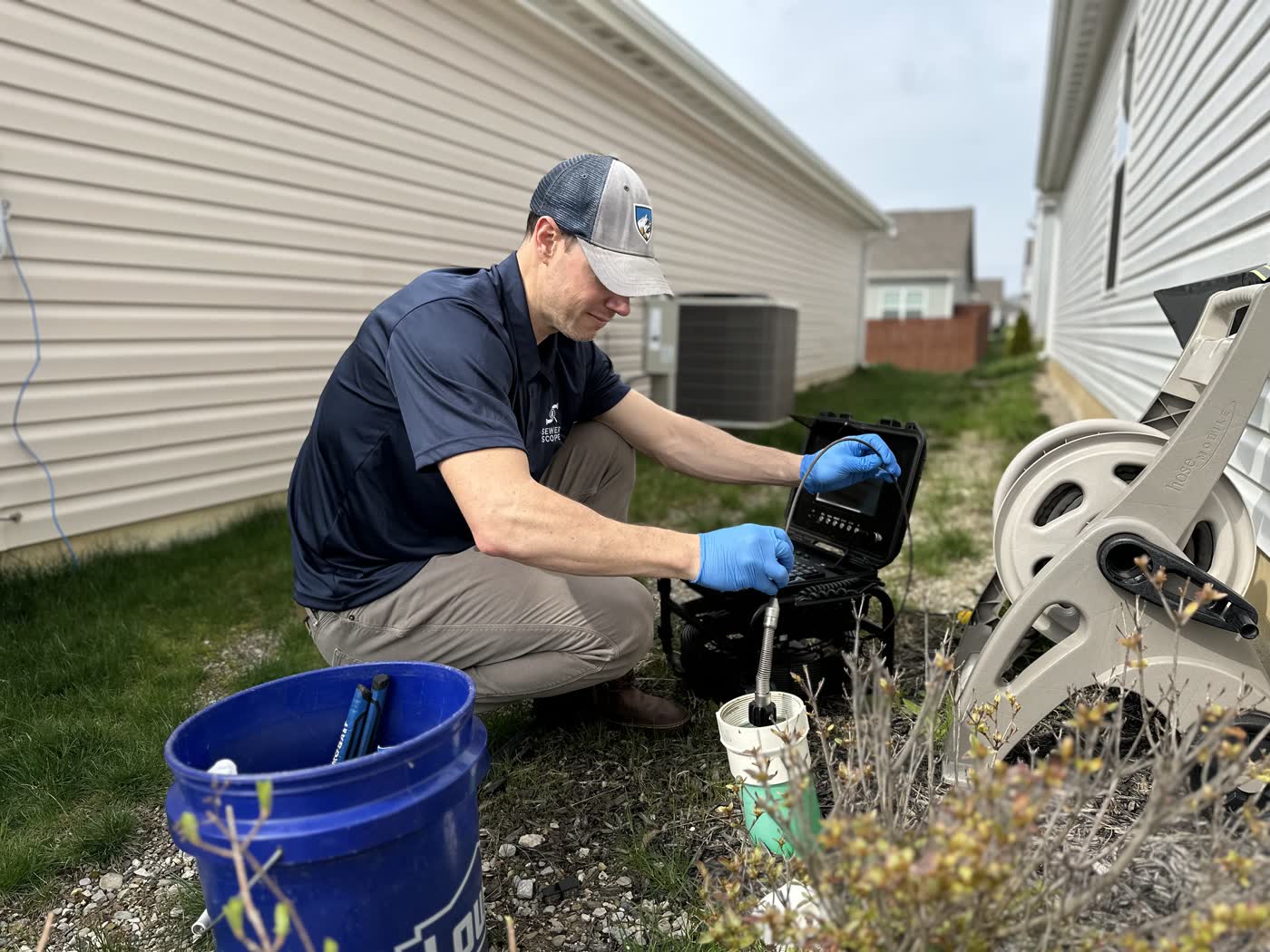
Mason inspections run on the same platform every Sewer Scope metro uses. Booking by phone at (513) 201-8833 or online. Same-week appointment standard. The technician arrives in the inspection-period window, locates the cleanout (easy on any post-1990 Mason build with a standard yard cleanout, sometimes basement-only on the 1880s downtown pocket), runs the camera from access to the Mason Utility Department tap, and packs out. The report follows in roughly 24 hours, distributed to buyer, agent, plumber, and lender.
Mason-specific notes: long lateral runs on Heritage Club and Wetherington larger lots can push on-site time longer. Downtown historic pocket scopes sometimes require interior stack access.
For Mason homes built after 1990 the lateral is almost always PVC, so the defect-find rate is lower than older areas, but it is not low: even newer homes fail a sewer scope about 40% of the time, so a scope is still worth it as cheap insurance and as Ohio disclosure protection. For Mason homes in the 1880s downtown Main Street historic pocket, scope is essentially mandatory due diligence because original laterals there are clay tile and first-generation cast iron. Heritage Club and Wetherington subdivisions are uniformly PVC mid-life.
Source: U.S. Census Mason City Ohio QuickFactsThe Mason Utility Department operates the city's water and sewer infrastructure. Mason runs its own combined utility billing and connection-fee structure. Lateral ownership runs from the home to the city right-of-way boundary. The City of Mason is one of the more straightforward jurisdictions in the Cincinnati metro for documentation requests and tap-permit administration.
Source: City of Mason governmentThe Procter & Gamble Mason Business Center at 8700 Mason Montgomery Road is P&G's largest research and development site and one of the largest single-employer corporate campuses in the Cincinnati metro. P&G's expansion drove the residential growth around the Mason Montgomery corridor through the 1990s and 2000s, meaning housing inventory in those subdivisions is uniformly PVC and roughly contemporary. Defect-find rates in P&G-corridor subdivisions are lower than the older cores, though even newer homes fail a sewer scope about 40% of the time, so a scope is still worth it.
Source: Procter & Gamble U.S. locationsThe original downtown Mason platting dates to the 1880s, with most original homes around East Main Street, Reading Road, and the Western Row Road historic blocks built 1880 to 1930. Original laterals are vitrified clay tile in short mortared sections, in many cases never replaced. The defect catalog mirrors Cincinnati's streetcar-era neighborhoods. Scope is strongly recommended for any purchase in this pocket.
Source: City of Mason community resourcesKings Island opened in 1972 on the Mason / Kings Mills border and the entertainment corridor along Western Row Road and the I-71 / Kings Mills exit drove substantial residential growth from the late 1970s through the 1990s. Homes built 1972 to 1985 in this corridor sit in the transitional era when Orangeburg was being phased out and PVC was phasing in. Most have been replaced once or have PVC originals. Worth scoping because the era is mixed.
Source: Kings IslandYes. Ohio Revised Code 5302.30 applies statewide and requires the seller to complete an Ohio Residential Property Disclosure Form. The form has explicit sewer, water, and septic system questions. A documented pre-sale scope helps a Mason seller answer those questions accurately and defensibly, which materially reduces post-closing dispute risk.
Source: Ohio Revised Code 5302.30Mason is the highest-volume Warren County market for Cincinnati Area Board of Realtors (CABR) members (per Cincinnati Area Board of Realtors). The scope conversation here is straightforward: cheap insurance plus Ohio disclosure protection on the post-1990 stock, essentially mandatory on the 1880s downtown Main Street pocket. Ohio Revised Code 5302.30 already requires sewer-system disclosure. Same professional report and high quality video. Same 24-hour turnaround. Same clean handoff. The Realtor Partner Program covers the pre-sale scope add-on and pay-after-inspection billing.
Mason, Lebanon, Springboro, Franklin. The Cincinnati growth county. Post-1990 PVC dominant.
The Cincinnati urban core, hillside neighborhoods, planned communities. Highest defect-rate county in the metro.
I-75 corridor, Union Centre, 1990s-2010s PVC dominant. No historic core.
Liberty Way / Liberty Center retail, 2000-2015 build dominant, county sewer service.