
Butler County is the most era-bifurcated market in the Cincinnati metro. The historic cores (Hamilton city, Middletown, Oxford near Miami University) hold pre-1940 housing stock with the full Cincinnati defect catalog. West Chester Township, Liberty Township, and most of Monroe are post-1990 PVC, lower defect-find rates than the older cores, though even newer homes fail a sewer scope about 40% of the time. Same buyer's market, two completely different scope conversations depending on the address. About 25 minutes on camera resolves which one applies. The American Community Survey reports Butler County's median housing unit was built in 1985, almost three decades newer than Hamilton County Ohio, a difference you can read in every camera run.
Butler County sits directly north of Hamilton County across roughly 471 square miles. The 2020 census put the population at 390,357 (per U.S. Census Bureau QuickFacts), making it the second-largest county in the Cincinnati metro. The geography is two distinct populations: the older river-city corridor (Hamilton, Middletown, Fairfield, Monroe) along the Great Miami River and the post-1990 suburban explosion along the I-75 corridor (West Chester Township, Liberty Township, the eastern half of Fairfield).
Hamilton, Ohio is the Butler County seat and a pre-Civil-War river city. The original urban core blocks (Main Street, High Street, Heaton Street, the Lindenwald and Rossville neighborhoods) hold housing stock built 1850 to 1930. Hamilton sits at the confluence of the Great Miami River and Two Mile Creek, and floodplain alluvial soils drive belly formation on top of the age-driven defect catalog. Original laterals are clay tile with cast iron displacement in the 1900 to 1940 era. The City of Hamilton operates its own sewer system within city limits (per City of Hamilton Water and Sewer).
Middletown is the second river city, sitting between Hamilton and Dayton along the Great Miami. Founded 1791, the original housing stock runs 1850 through the 1940s, with a heavy industrial-era expansion driven by the AK Steel (formerly Armco) plant. The original residential blocks south of Central Avenue and around the South Main historic district carry the same pre-1940 cast iron and clay tile risk as Hamilton. The post-1960 subdivision belt on the city periphery shifts to Orangeburg and early PVC.
Fairfield sits between Hamilton city and the I-75 corridor. The original Fairfield blocks near Wayne Avenue and Pleasant Avenue date to the 1900 to 1940 era. The bulk of Fairfield's housing stock is mid-century to early 21st century, with significant 1950s through 1980s subdivision development. Orangeburg risk concentrates in the 1950 to 1972 sections. PVC dominates post-1980 builds.
Oxford is the Miami University town in the northwest corner of the county. The original residential blocks near campus (Western Row, the Bishop Hall area, the Hawthorne Avenue corridor) were built 1880 to 1930 to serve faculty and town residents. Original laterals there are vitrified clay tile and first-generation cast iron. The post-1990 student-rental subdivision belt on the Oxford periphery shifts to PVC, but the historic core blocks carry the same age-driven defect profile as Hamilton County's streetcar belt. Miami University, founded 1809, is one of the oldest public universities in the United States (per Miami University history), and the surrounding town predates the railroad era.
West Chester Township and Liberty Township are the I-75 corridor growth story. West Chester is now home to roughly 65,000 residents per the U.S. Census Bureau, up from under 10,000 in 1980. Liberty Township sits north and has grown similarly. The build-out is dominated by 1990 through 2015 PVC construction. Union Centre in West Chester and Liberty Way in Liberty Township are the commercial spines that drove the residential growth. No historic core to speak of in either township. The Butler County Water and Sewer Department serves both townships (per Butler County Water and Sewer).
Soil across Butler County is dominated by Russell silt loam and Miamian silt loam on the rolling uplands, with alluvium along the Great Miami River corridor and Mill Creek. The Russell-Miamian sequence is glacial till with substantial plastic clay content (per USDA NRCS Web Soil Survey). The newer PVC stock in West Chester and Liberty handles wet-dry cycling well, but early 1990s PVC installs sometimes show belly formation today because bedding standards varied across the builder boom of that era.
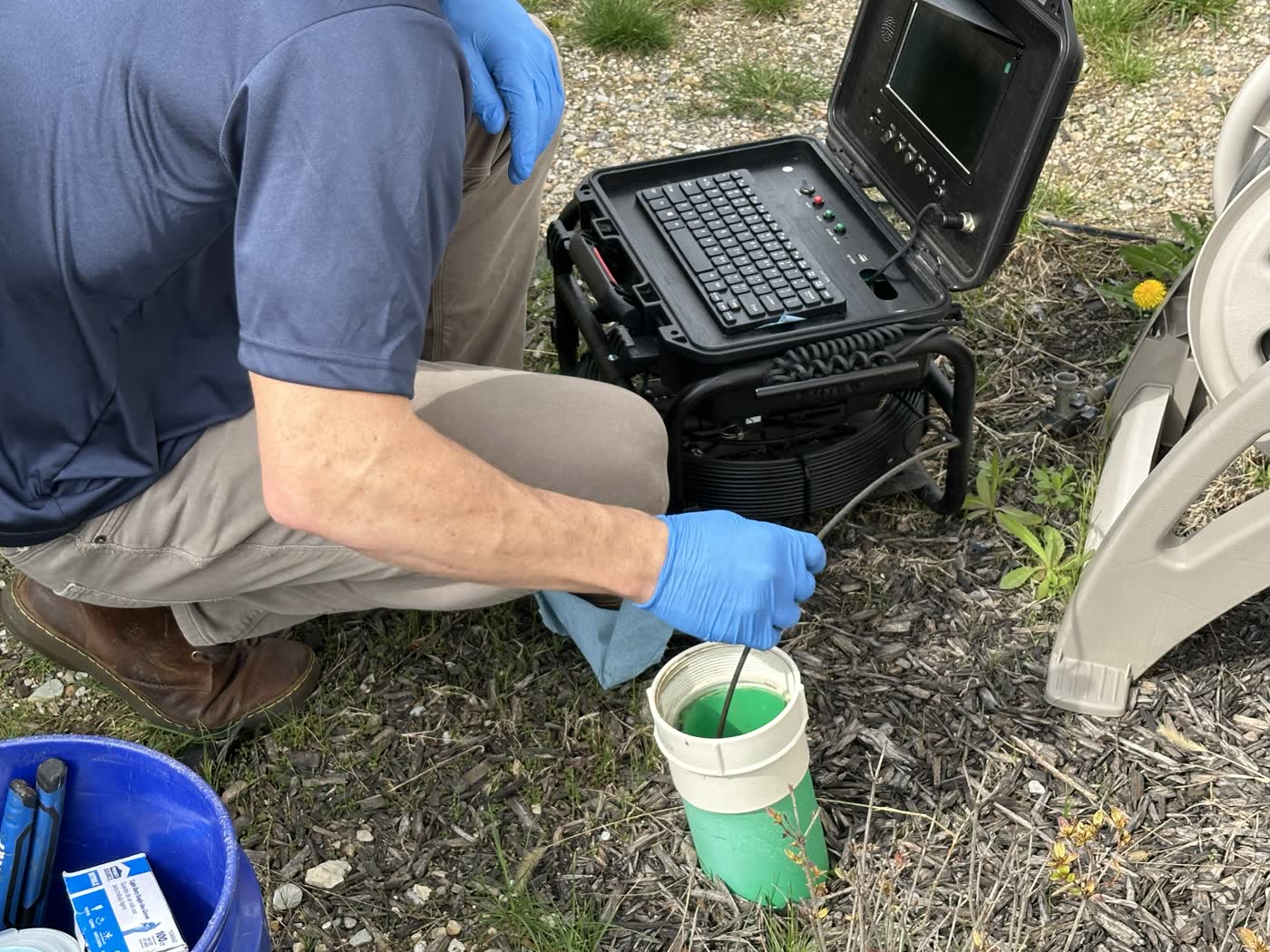
1. PVC joint separation and root intrusion at joints (most common West Chester / Liberty Township finding). PVC laterals carry a long documented service life (50+ years with proper installation per Uni-Bell PVC Pipe Association) but freeze-thaw movement in Butler County's glacial-till clay slowly pulls joints apart over a 20 to 30 year window. On camera: visible hairline roots threading through a clean PVC joint, or a small step where the section has shifted. Repair runs $1,500 to $5,000 for trenchless lining or $1,500 to $4,000 for spot excavation. The early 1990s PVC builds in West Chester are now hitting the 30-year mark, which is when this finding starts to appear with measurable frequency.
2. Cast iron scale on any pre-1980 Hamilton or Middletown build. Cast iron laterals were the standard in the Butler County river cities from the 1900s through the late 1960s. Documented service life is 50 to 75 years (per the Cast Iron Soil Pipe Institute), putting almost every original Butler County cast iron lateral at end-of-life today. On camera: heavy scale buildup on the pipe floor, often narrowing the effective diameter from a 4-inch nominal to 2 inches or less. Descaling runs $200 to $800 in the Cincinnati metro. The Hamilton city core, the Middletown South Main district, and the older Oxford blocks all carry this risk uniformly.
3. Clay tile joint offset and root intrusion (every pre-1940 block in Hamilton, Middletown, Oxford). Vitrified clay tile was the standard in Butler County river cities before cast iron displaced it. Clay tile is laid in short sections joined by mortar. Mortar fails first. Root intrusion through failed mortar is the highest-frequency finding on pre-1940 Hamilton, Middletown, and Oxford properties. ASCE identifies root intrusion as one of the leading causes of sanitary sewer overflow nationally (per ASCE Infrastructure Report Card on wastewater). Repair runs $1,500 to $5,000 for root cutting and hydro-jetting through $350 to $600 for trenchless joint lining.
4. Orangeburg in the post-WWII subdivision belt (Fairfield, Middletown periphery, late-build Hamilton). Orangeburg was used heavily in Butler County's post-war suburban expansion when cast iron was rationed. The Fairfield 1950s through 1972 subdivisions are the highest-density Orangeburg pocket in the county. Documented mean failure age is 30 to 50 years (per U.S. EPA pipe materials reference). Every Orangeburg lateral in Butler County is now past expected service life. Repair is full replacement, $4,000 to $15,000 plus Butler County or municipal permit fees.
5. Belly formation in early 1990s PVC laterals (West Chester, Liberty Township). PVC laterals installed in the early-to-mid 1990s sometimes show belly formation today because trench-bedding standards varied across the suburban-boom build-out. Butler County's plastic clay soils plus a borderline-shallow bury depth plus a quarter-inch of settling per year for 30 years equals a measurable belly. On camera: the camera tilts down then back up through a low spot, with water pooling in the dip. Belly repair runs $1,500 to $4,500 for the section work, comparable to Hamilton County rates because the per-foot excavation rates do not vary much across the metro.
6. Great Miami River and Two Mile Creek floodplain alluvial movement. Properties in the immediate Great Miami floodplain (lower Hamilton, the South Hamilton bottoms, parts of Middletown along the river) sit on alluvial soils that compact unevenly over decades. Even PVC laterals show belly formation in this geology. The Federal Emergency Management Agency floodplain maps (per FEMA Flood Map Service Center) document the affected sections precisely.
Butler County inspections run on the same platform as every other Sewer Scope metro. Booking by phone at (513) 201-8833 or online. Same-week appointment standard. The technician arrives in the inspection-period window, locates the cleanout, runs the camera from access to the city tap or county tap depending on jurisdiction, and packs out. The report follows in roughly 24 hours, distributed to buyer, agent, plumber, and lender.
Butler-specific notes: long suburban lateral runs in West Chester and Liberty Township sometimes push on-site time toward the longer end of the 30-to-60 minute typical window because larger lots mean longer distances from house to tap. Hamilton city pre-1940 properties often have basement-only cleanout access rather than yard cleanouts, requiring access through the interior stack.
Butler County is mixed. The historic cores of Hamilton (county seat), Middletown, and Oxford carry pre-1940 housing stock with cast iron and clay tile risk identical to the older Cincinnati neighborhoods. West Chester Township, Liberty Township, and most of Monroe are dominated by post-1990 PVC construction with low defect-find rates. Risk in Butler County is entirely an address question, and construction era resolves it.
Source: U.S. Census Bureau Butler County Ohio QuickFactsThe Butler County Water and Sewer Department operates the public sanitary sewer system across unincorporated areas including West Chester Township and Liberty Township. The City of Hamilton, Middletown, Fairfield, Monroe, and Oxford each operate their own municipal systems. Each jurisdiction sets its own connection fees, lateral ownership boundary, and contractor licensing requirements.
Source: Butler County Water and Sewer Department · City of Hamilton Water and SewerOxford's housing stock is older than the regional perception. The original residential blocks near Miami University were built largely 1880 to 1930 to serve faculty and town residents, and original laterals there are vitrified clay tile and first-generation cast iron. The post-1990 student-rental subdivision belt on the Oxford periphery is PVC, but the historic core blocks (Western Row, Bishop Hall area, Hawthorne Avenue corridor) carry the same age-driven defect profile as Hamilton County's streetcar belt.
Source: Miami University historyHamilton, Ohio is a pre-Civil-War river city. The original urban core blocks (Main Street, High Street, Heaton Street, Lindenwald and Rossville) hold housing stock built 1850 to 1930. Original laterals are clay tile with cast iron displacement in the 1900 to 1940 era. Hamilton sits at the confluence of the Great Miami River and Two Mile Creek, and floodplain alluvial soils drive belly formation on top of the age-driven defect catalog.
Source: City of Hamilton OhioYes. Both townships saw essentially zero residential development before 1980. The I-75 corridor build-out (Union Centre in West Chester, Liberty Way and Liberty Center in Liberty Township) drove explosive growth from the early 1990s through the 2010s. West Chester Township sits at roughly 65,000 residents in 2020, up from under 10,000 in 1980. PVC laterals dominate. The remaining risk is early 1990s PVC bedding variability.
Source: U.S. Census West Chester Township QuickFactsYes. Ohio Revised Code 5302.30 applies statewide and requires the seller to complete an Ohio Residential Property Disclosure Form. The form has explicit sewer, water, and septic system questions. Butler County listings range across every era, so the documented condition matters more here than in pure-newer markets. Pre-sale scope is one of the cheapest ways to defend the disclosure answers.
Source: Ohio Revised Code 5302.30Butler County is one of the highest-volume buyer markets in the Cincinnati metro for Cincinnati Area Board of Realtors (CABR) members (per Cincinnati Area Board of Realtors). The scope conversation here is bifurcated: on pre-1980 Hamilton, Middletown, or Oxford listings the scope is essentially mandatory due diligence, on West Chester or Liberty Township post-1990 listings it is cheap insurance and Ohio disclosure protection. Ohio Revised Code 5302.30 already requires sewer-system disclosure, and a documented pre-sale scope answers cleanly. Same professional report and high quality video. Same 24-hour turnaround. The Realtor Partner Program covers the pre-sale scope add-on and pay-after-inspection billing.
The Cincinnati urban core, hillside neighborhoods, planned communities. Highest defect-rate county in the metro.
Mason, Lebanon, Springboro, Franklin. Post-1990 PVC dominant except Lebanon downtown and Franklin core.
I-75 corridor, Union Centre, 1990s-2010s PVC dominant. No historic core.
Liberty Way / Liberty Center retail, 2000-2015 build dominant, county sewer service.