
Hamilton County is the Cincinnati core, and it carries the oldest housing stock in the metro. Over-the-Rhine and the West End hold pre-1900 buildings still on original clay tile and cast iron. Hyde Park, Mt Lookout, Mariemont, Norwood, and Walnut Hills are 1900 to 1940 streetcar-era neighborhoods sitting squarely in the cast iron and Orangeburg failure window. The U.S. Census Bureau reports the median Hamilton County housing unit was built in 1958, which means roughly half the inventory is at or beyond documented service life on original lateral material. The scope conversation in Hamilton County is not "do I need one." It is "which defect catalog applies to this address." About 25 minutes on camera answers it.
Hamilton County covers roughly 414 square miles along the Ohio River and the Mill Creek valley. The 2020 census put the county at 830,639 residents, with the City of Cincinnati at 309,317 (per U.S. Census Bureau QuickFacts). Unlike the suburban growth counties to the north, Hamilton County's housing stock is concentrated in the pre-1980 window, and large swaths of it are pre-1940. The defect-find rate on a Hamilton County scope reflects that age distribution directly.
Over-the-Rhine, the West End, and the urban basin hold the county's oldest residential structures, with original construction running from the 1850s through the 1880s. The Italianate brick rowhouses of OTR are still mostly served by original clay tile and first-generation cast iron, in many cases laid before the Cincinnati combined sewer system was even unified. Mill Creek floodplain saturation accelerates joint movement and belly formation in this stock.
Hyde Park, Mt Lookout, Oakley, and Walnut Hills are Cincinnati's streetcar-era residential belt, built largely 1900 to 1940. The bungalow and four-square housing stock here is the textbook cast iron and clay tile window. Norway maple and pin oak street trees planted as the neighborhoods went in are now 80+ years old, producing aggressive root systems that find every joint gap. Hyde Park is the single highest-priority scope target in the Cincinnati metro by defect concentration in our camera log.
Mariemont sits on its own as one of the earliest planned communities in the United States, platted by John Nolen in 1923 and built largely 1923 to 1932. The Tudor-revival housing stock is still mostly original, served by clay tile laterals from the 1920s install. Mariemont's mature canopy is one of the most root-aggressive in the county. The Mariemont Preservation Foundation maintains historical records of the original utility installations (per Mariemont Preservation Foundation) that confirm the original material runs.
Indian Hill, Terrace Park, and Mt Lookout estate sections mix original 1920s through 1950s estates with heavy post-1990 luxury infill. The older estate homes carry the same cast iron and clay tile risk as any pre-1960 Cincinnati property. The newer estate sections are PVC. Many of the larger acreage parcels in Indian Hill remain on private septic rather than connecting to the MSD combined system, especially on the eastern edge toward the Little Miami River.
Norwood is the enclave inside Cincinnati, geographically surrounded by the city but its own incorporated municipality. The housing stock is 1900 to 1940 streetcar-era residential surrounding the former General Motors plant footprint. Same cast iron and clay tile risk profile as Hyde Park, with elevated belly risk in the lower-elevation sections that drained toward Duck Creek before the creek was largely culverted.
Mt Adams, Mt Auburn, Clifton (Gaslight District), and Price Hill are the hillside neighborhoods. Steep grade on Ohio Shale and Kope Formation limestone bedrock means laterals run at aggressive pitch, which accelerates offset-joint failure. Hillside slippage on saturated shale pulls laterals out of alignment over decades. The Ohio Geological Survey (per Ohio Geological Survey) maps the Cincinnati area as a textbook example of Kope Formation siltstone and shale, the same formation that drives the city's well-documented hillside stability issues.
Soil across the rolling-but-not-hillside sections of Hamilton County is mapped predominantly Rossmoyne silt loam and Avonburg silt loam, residuum over the Kope and Fairview formations, with alluvium along Mill Creek and the Little Miami River corridor (per USDA NRCS Web Soil Survey). The plastic clay content drives the same wet-dry cycling and freeze-thaw movement seen in the Indianapolis metro, but the older lateral installs mean a much higher fraction of Hamilton County's stock is past the failure threshold.
1. Cast iron scale on any pre-1980 Hamilton County build (most common finding). Cast iron laterals were the Cincinnati standard from the 1900s through the late 1960s. Documented service life is 50 to 75 years under typical conditions (per the Cast Iron Soil Pipe Institute), which puts almost every original Hamilton County cast iron lateral at end-of-life today. On camera: heavy scale buildup on the pipe floor, often narrowing the effective diameter from a 4-inch nominal to 2 inches or less. Cincinnati-area descaling rates run $200 to $800 depending on length and access. Descaling restores function for another 5 to 15 years, but does not undo wall thinning, so a follow-up scope at 5 years is recommended.
2. Orangeburg in the 1945 to 1972 window (Kenwood, Bond Hill, parts of Roselawn, late-build Norwood). Orangeburg (bituminous fiber conduit) was used heavily in Cincinnati during the post-war building boom when cast iron was rationed. Documented mean failure age is 30 to 50 years (per U.S. EPA pipe materials reference), which means every Orangeburg lateral in Cincinnati is now past expected service life. On camera: deformed oval cross-section, blistered interior wall, often partial collapse. Repair is full replacement. Cincinnati-area Orangeburg replacement runs $4,000 to $15,000 plus MSD permit and connection fees.
3. Clay tile joint offset and root intrusion (every pre-1940 neighborhood). Vitrified clay tile was the Cincinnati standard before cast iron displaced it in the 1920s and 1930s. Clay tile is laid in short sections (typically 2 to 4 feet) joined by mortar. Mortar fails first. Root intrusion through failed mortar joints is the most common finding in Hyde Park, Mariemont, Walnut Hills, and Over-the-Rhine inspections. The American Society of Civil Engineers identifies root intrusion as one of the leading causes of sanitary sewer overflow nationally (per ASCE Infrastructure Report Card on wastewater). Repair runs from $1,500 to $5,000 for root cutting and hydro-jetting through $350 to $600 for trenchless joint lining.
4. Hillside offset on Mt Adams, Clifton, Price Hill, Mt Auburn. Cincinnati's hillside neighborhoods sit on Kope Formation limestone and shale. Saturated shale moves, and the lateral moves with it. On camera: visible step-offset at one or more joints where the downhill section has dropped below the uphill section. Repair on a hillside Cincinnati lot is materially more expensive than on flat ground because excavation depth and access constraints both work against you. Hillside offset repair runs $1,500 to $4,000 plus the MSD permit. Trenchless lining is often the only viable option on the steepest grades.
5. Mill Creek and Ohio River alluvial belly formation. Properties in the Mill Creek floodplain (Camp Washington, lower West End, parts of Northside) and the Ohio River bottoms (East End, Riverside, parts of Sayler Park) sit on alluvial soils that compact unevenly over decades. Even PVC laterals show belly formation in this geology. On camera: the camera tilts down then back up through a low spot, with standing water in the dip. Belly repair runs $1,500 to $4,500 for a single section.
One additional Hamilton County variable: the MSD operates a combined sewer system across most of the city core, meaning stormwater and sanitary share the same main. MSD is under a long-term consent decree with the U.S. EPA (the Lower Mill Creek Partial Remedy and broader CSO control program, per U.S. EPA Cincinnati sewer overflow program) to reduce overflow events. The practical effect on a homeowner: backup risk during heavy rain events is documented and ongoing, and an MSD-approved backwater valve is often a reasonable add after a scope reveals lateral condition.
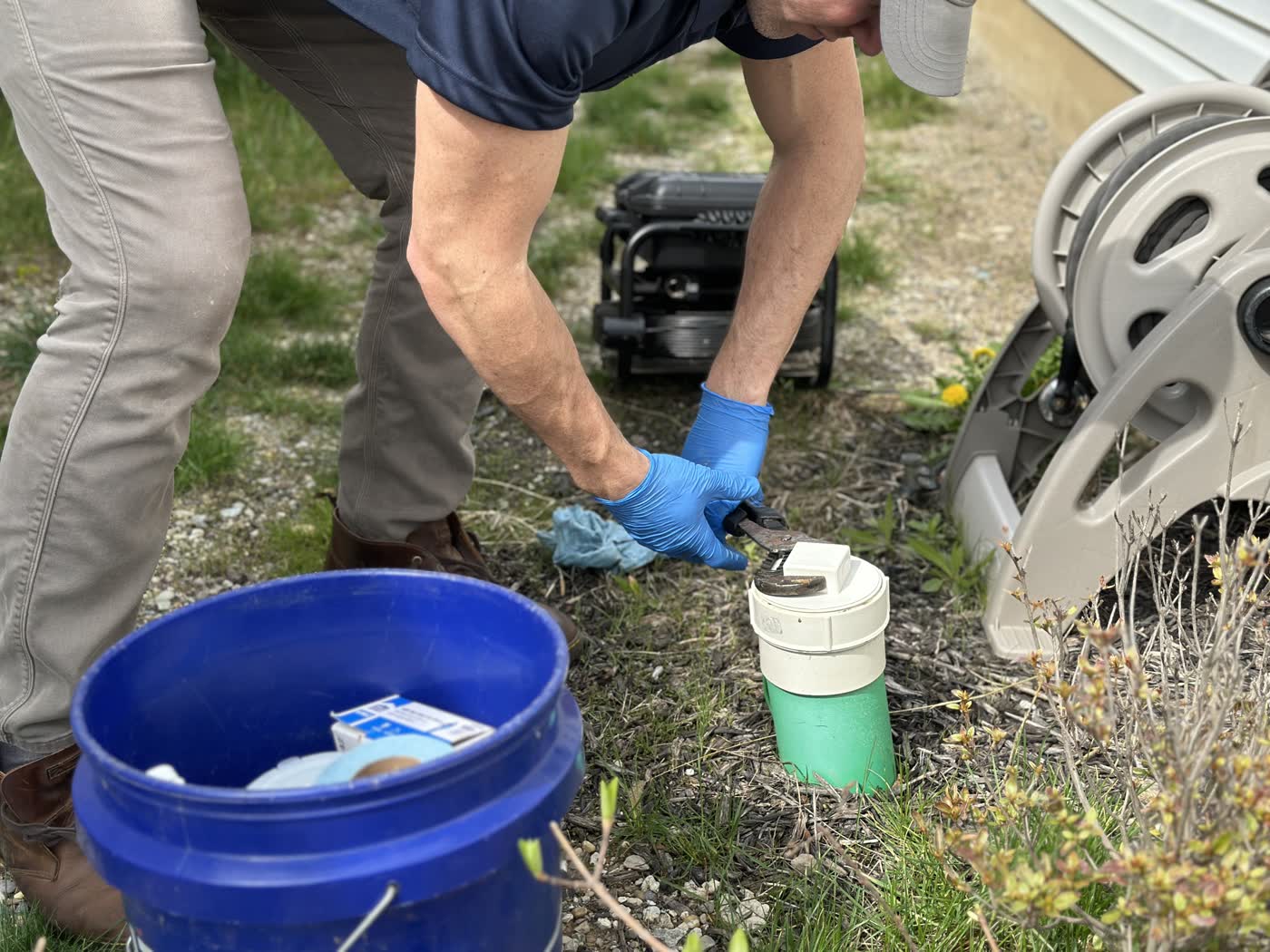
Hamilton County inspections run on the same platform every Sewer Scope metro uses. Booking by phone at (513) 201-8833 or online. Same-week appointment standard. The technician arrives in the inspection-period window, locates the cleanout (often inside the basement on pre-1940 Cincinnati builds rather than in the yard), runs the camera from access to the MSD city tap with footage marked, and packs out. The report follows in roughly 24 hours, distributed to buyer, agent, plumber, and lender as requested.
Cincinnati-specific notes: hillside properties (Mt Adams, Clifton, Price Hill) sometimes need additional access setup because the lateral run is steep and the cleanout location is non-standard. Pre-1900 Over-the-Rhine and West End buildings frequently have no exterior cleanout at all, requiring access through a basement toilet or a removed cleanout cap on the interior stack. We confirm access during booking.
Hamilton County's housing stock skews older than Butler or Warren by a wide margin. The U.S. Census Bureau reports the median Hamilton County housing unit was built in 1958, meaning roughly half the inventory is at or beyond the documented service life of original cast iron and clay tile laterals. Add the pre-1900 OTR and West End, the 1900 to 1940 streetcar belt (Hyde Park, Mt Lookout, Norwood, Walnut Hills), and the 1923 Mariemont planned community, and you have the highest defect-find rate in the metro.
Source: U.S. Census Bureau Hamilton County Ohio QuickFactsThe Metropolitan Sewer District of Greater Cincinnati (MSD) operates the public sanitary and combined sewer system serving Cincinnati and most of Hamilton County. MSD is operated by the City of Cincinnati under a long-term consent decree with the U.S. EPA covering wet-weather overflow control. Greater Cincinnati Water Works (GCWW) handles drinking water. Lateral ownership runs from the home to the property line in most MSD jurisdictions, with MSD responsible past the right-of-way boundary.
Source: Metropolitan Sewer District of Greater Cincinnati · U.S. EPA Cincinnati sewer overflow programYes. Mariemont was platted in 1923 as one of the earliest planned communities in the United States, designed by John Nolen and built largely 1923 through the early 1930s. The Tudor-revival housing stock is still mostly original. Laterals from that era are vitrified clay tile in short mortared sections, in some cases replaced once with Orangeburg during the 1945 to 1972 window. The mature canopy of original 1920s plantings drives one of the highest root-intrusion frequencies in the metro.
Source: Mariemont Preservation FoundationCincinnati's hillside neighborhoods sit on Kope Formation limestone and shale, a textbook example of the Cincinnatian Series mapped by the Ohio Geological Survey. Steep grade means laterals run at aggressive pitch, which accelerates offset-joint failure. Hillside slippage on saturated shale pulls laterals out of alignment over decades. Pre-purchase scope is essentially mandatory due diligence on any hillside Cincinnati listing because the failure-mode catalog is unique to this geology.
Source: Ohio Geological SurveyYes. Ohio Revised Code 5302.30 requires the seller to complete an Ohio Residential Property Disclosure Form. The form has explicit questions about water, sewer, and septic systems including known defects, sewer service type, and any history of backups or repairs. A documented sewer scope before listing helps a Cincinnati seller answer those questions accurately and defensibly, which materially reduces post-closing dispute risk.
Source: Ohio Revised Code 5302.30It depends on the parcel size and location. Many of the larger acreage parcels in Indian Hill remain on private septic rather than connecting to the MSD combined system, especially on the eastern edge toward the Little Miami River. The Hamilton County Public Health environmental health division administers on-site sewage system permitting and inspection. A pre-purchase scope on a septic property terminates at the tank inlet rather than a city tap, and the camera also documents inlet condition.
Source: Hamilton County Public HealthHamilton County is the highest-volume buyer market in the Cincinnati metro for Cincinnati Area Board of Realtors (CABR) members (per Cincinnati Area Board of Realtors). The scope conversation here is straightforward: on any pre-1980 listing, a scope is essentially mandatory due diligence. Ohio Revised Code 5302.30 makes that conversation easier still: the seller's disclosure form already requires sewer-system answers, and a documented pre-sale scope answers them cleanly. Same professional report and high quality video. Same 24-hour turnaround. Same clean handoff with no repair upsell. The Realtor Partner Program covers the pre-sale scope add-on and pay-after-inspection billing.
Hamilton, Middletown, Fairfield, Oxford. Mostly 1990s-2000s PVC in WC and Liberty, older clay in the historic cores.
Mason, Lebanon, Springboro, Franklin. Post-1990 PVC dominant except Lebanon downtown and Franklin core.
P&G Mason campus corridor plus 1990s-2000s build-out plus 1880s downtown clay.
I-75 corridor, Union Centre, 1990s-2010s PVC dominant. No historic core.