
Liberty Township is the youngest residential stock in the Cincinnati metro. Build-out happened later than every other township or city we cover, with the bulk of residential development running 2000 through 2020. Most laterals here are 10 to 25 years old, well inside documented PVC service life, on standardized modern bedding. There is no historic core, no Orangeburg-era subdivision pocket, no pre-1990 housing of any meaningful scale. The defect-find rate is among the lower readings in the metro, but it is not low: even newer homes fail a sewer scope about 40% of the time. The scope conversation in Liberty Township is essentially cheap insurance and Ohio disclosure protection, plus documentation for the buyer's records. About 25 minutes on camera produces the report that closes the file.
Liberty Township covers roughly 33 square miles in northern Butler County, bordered by West Chester Township to the south and Monroe to the north. The 2020 census put the township at roughly 42,000 residents (per U.S. Census Bureau QuickFacts), up from roughly 25,000 in 2000. Like West Chester, Liberty Township is unincorporated, meaning it operates under township and county governance rather than as a chartered municipality. Critically, this means there is no Liberty Township municipal utility. Sewer service runs through the Butler County Water and Sewer Department.
The growth story is the Liberty Way and Liberty Center corridor. Liberty Way is the major east-west arterial running across the township, connecting I-75 to State Route 747. Liberty Center opened in 2015 as one of the largest greenfield outdoor mixed-use retail developments in the Cincinnati metro, anchored at the intersection of Liberty Way and Cox Road. Liberty Center pulled commercial growth that pulled residential growth behind it, and the subdivisions adjacent to the Liberty Way / Cox Road corridor are uniformly PVC and roughly contemporary, mostly 2005 to 2020.
The major Liberty Township subdivision developments include the Four Bridges golf-course communities (which span the Liberty / West Chester border with the bulk in West Chester), the Berkeley Square area, the Heatherwoode development, and the Beckett Park communities. The earlier 1990s subdivisions on the western side of the township (Beckett Park area, the Princeton Road corridor) are essentially the only stock that crosses the 30-year threshold where early-PVC findings start to appear.
Liberty Township has no pre-1940 housing core to speak of. The original Liberty platting was rural agricultural with scattered farmsteads, and there is no streetcar-era residential belt because no streetcar ever ran here. A handful of scattered 1950s and 1960s ranches survive on Princeton Road and the older county roads, but they are statistical noise relative to the overall housing inventory.
The Butler County Water and Sewer Department serves the township under the same county jurisdiction as West Chester (per Butler County Water and Sewer). The county sets connection fees, lateral ownership boundary, and contractor licensing requirements. There is no Liberty Township municipal utility because the township is not chartered as a city. The Butler County system has been progressively expanded to keep pace with the township's growth, with most laterals in Liberty Township contemporary to the subdivision build-out.
Soil under Liberty Township is mapped predominantly Russell silt loam and Miamian silt loam on the uplands, with Genesee and Eel silt loams along the Mill Creek and Pleasant Run drainages (per USDA NRCS Web Soil Survey). The Russell-Miamian sequence is glacial till with substantial plastic clay content, the same as Butler County's other townships. The newer PVC stock handles wet-dry cycling well, and the late-build-out era means most installs used current standards for bedding and joint sealing.
Liberty Township's tree canopy is younger than even West Chester's. The subdivision-era street tree palette favored red maple, sugar maple, sweetgum, and locust, with Bradford pear used heavily in the 2000s before its structural weakness became fully understood. Root intrusion findings on Liberty Township PVC are essentially nil at this stage of the lateral inventory's life. The U.S. Department of Agriculture Natural Resources Conservation Service catalogs the regional canopy patterns precisely (per USDA NRCS).
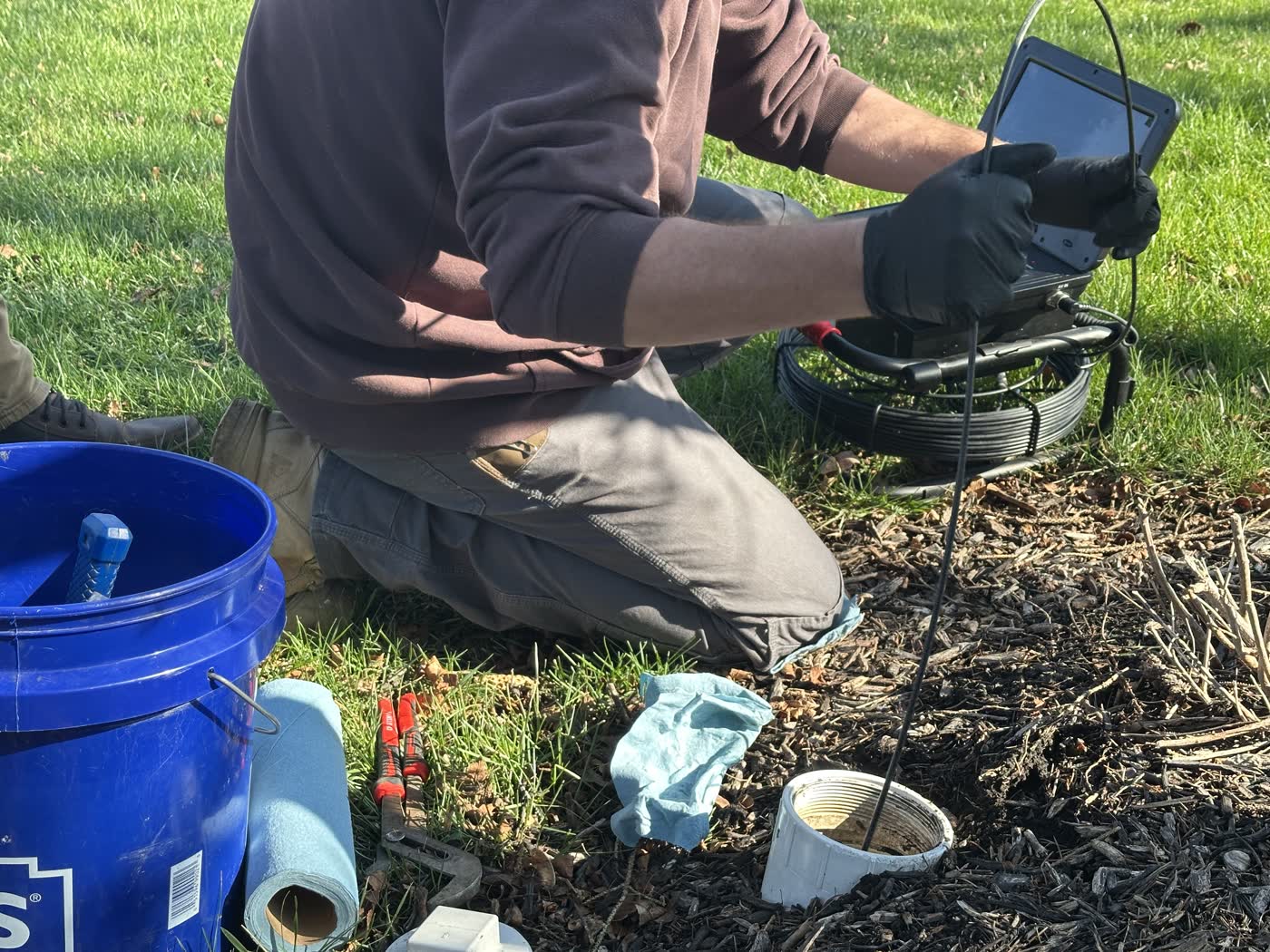
1. PVC joint separation in early 1990s Beckett Park and Princeton Road corridor installs (rare, but the most common Liberty Township finding). PVC laterals carry a documented service life of 50+ years (per Uni-Bell PVC Pipe Association) but freeze-thaw movement in Butler County's plastic-clay soils gradually pulls joints apart over a 20 to 30 year window. The few early 1990s Liberty Township installs are now hitting that threshold. On camera: visible hairline roots threading through a clean PVC joint. Repair runs $1,500 to $4,000 for trenchless lining or $1,500 to $4,000 for spot excavation. Statistically rare in Liberty Township because the bulk of the housing stock is much newer.
2. Belly formation in early 1990s Liberty Township PVC laterals. The few early Liberty installs (Beckett Park area, Princeton Road corridor) sometimes show belly formation today because trench-bedding standards varied across the earliest 1990s builders. Butler County's plastic clay soils plus a borderline-shallow bury depth plus a quarter-inch of settling per year for 30 years equals a measurable belly. On camera: the camera tilts down then back up through a low spot, with water pooling in the dip. Belly repair runs $1,500 to $4,500 for the section work. Statistically rare relative to the bulk of the 2000s-and-newer Liberty Township stock.
3. Long-run lateral findings on larger Four Bridges and Heatherwoode lots. Some Liberty Township larger lots have lateral runs exceeding 140 feet from house to tap. The longer the run, the more joints, the more opportunities for root intrusion or belly formation. Even on 2010-era PVC, long-run scopes occasionally show minor root encroachment at joints from mature trees on the original Four Bridges golf-course plantings. Repair is typically a one-shot trenchless lining at the affected joint.
4. Pre-1990 ranch outliers on Princeton Road and the older county roads (very rare). A handful of scattered 1950s and 1960s ranches survive on Princeton Road and the older Liberty Township county roads. These can still have original cast iron stacks and lateral stubs, or rare Orangeburg outliers. Documented service life for cast iron is 50 to 75 years (per the Cast Iron Soil Pipe Institute) and 30 to 50 years for Orangeburg (per U.S. EPA pipe materials reference). On the rare pre-1970 Liberty Township ranch, scope is essentially mandatory due diligence.
5. PVC bedding settling in the earliest Liberty Center perimeter subdivisions. Some subdivisions immediately adjacent to the Liberty Center / Liberty Way corridor were built on backfilled commercial-grading ground. The American Society of Civil Engineers tracks differential settling as a documented PVC lateral failure mode in mixed-grading sites (per ASCE Infrastructure Report Card on wastewater). On camera: gradual sag through the section with the most settling. Statistically rare but worth flagging on properties with documented fill history.
One Liberty Township-specific variable: the township has no historic core, no streetcar belt, no Orangeburg pocket, no clay tile inventory. Liberty Township carries a lower defect-find rate than the older Cincinnati cores because the lateral inventory was installed on modern standards by builders who knew what they were doing. Even so, it is not low: even newer homes fail a sewer scope about 40% of the time, so a scope is still worth it as cheap insurance. The small early-1990s pocket and the rare pre-1970 ranch are the exceptions worth flagging.
Liberty Township inspections run on the same platform every Sewer Scope metro uses. Booking by phone at (513) 201-8833 or online. Same-week appointment standard. The technician arrives in the inspection-period window, locates the cleanout (easy on any post-2000 Liberty Township subdivision with a standard yard cleanout), runs the camera from access to the Butler County Water and Sewer tap, and packs out. The report follows in roughly 24 hours, distributed to buyer, agent, plumber, and lender.
Liberty Township-specific notes: long lateral runs on Four Bridges, Heatherwoode, and other larger-lot subdivisions can push on-site time slightly. Most inspections finish at the shorter end of the 30-to-60 minute typical window because the lateral material is uniform and the findings are usually documentation-only.
Yes. Liberty Township is one of the lower-risk markets we record. Build-out happened later than West Chester, with the bulk of residential development running 2000 through 2015. Most laterals here are 10 to 25 years old, which is well inside documented PVC service life. There is no historic core. There is no Orangeburg-era subdivision pocket. The defect-find rate is among the lower readings in the Cincinnati metro, but it is not low: even newer homes fail a sewer scope about 40% of the time, so a scope is still worth it as cheap insurance and to document the lateral.
Source: U.S. Census Liberty Township QuickFactsThe Butler County Water and Sewer Department serves Liberty Township. Liberty Township is an unincorporated township, meaning it operates under county rather than municipal jurisdiction for water and sewer service. The county sets connection fees, lateral ownership boundary, and contractor licensing requirements. There is no Liberty Township municipal utility because the township is not chartered as a city.
Source: Butler County Water and Sewer · Liberty Township governmentLiberty Center is a major outdoor mixed-use retail development at the intersection of Liberty Way and Cox Road, opened 2015 as one of the largest greenfield commercial developments in the Cincinnati metro. Liberty Way is the major east-west arterial running across the township. The two anchor the township's commercial core, and the residential growth around them is concentrated 2005 through 2020.
Source: Liberty CenterLiberty Township built out later than West Chester. West Chester's growth wave ran 1985 through 2010 with the bulk of stock from the 1990s. Liberty Township's growth wave ran 2000 through 2020 with the bulk of stock from the 2000s and 2010s. The practical effect: Liberty Township laterals are typically newer and the defect-find rate is even lower than West Chester's. Both townships share the same Butler County Water and Sewer jurisdiction and the same Russell-Miamian glacial-till soils.
Source: U.S. Census Bureau QuickFactsOhio townships are not chartered municipalities. Townships have limited self-governance powers compared to cities, and water and sewer service is typically handled at the county level rather than the township level. Liberty Township residents pay sewer fees to Butler County rather than to a township utility. The township government handles zoning, fire, police, and parks but not utilities. This is the standard arrangement for unincorporated suburban Ohio townships.
Source: Ohio Township AssociationYes. Ohio Revised Code 5302.30 applies statewide and requires the seller to complete an Ohio Residential Property Disclosure Form. The form has explicit sewer, water, and septic system questions. A documented pre-sale scope helps a Liberty Township seller answer those questions accurately and defensibly, even on the newest PVC stock. The cost of a pre-sale scope is dwarfed by the post-closing dispute risk it eliminates.
Source: Ohio Revised Code 5302.30Liberty Township is one of the highest-growth markets in the Cincinnati metro for Cincinnati Area Board of Realtors (CABR) members (per Cincinnati Area Board of Realtors). The scope conversation here is "cheap insurance plus Ohio disclosure protection" because the defect-find rate is lower than the older Cincinnati cores, though even newer homes fail a scope about 40% of the time, so a scope is still worth it. Ohio Revised Code 5302.30 already requires sewer-system disclosure, and a documented pre-sale scope keeps those answers clean even on the newest stock. Same professional report and high quality video. Same 24-hour turnaround. Same clean handoff. The Realtor Partner Program covers the pre-sale scope add-on and pay-after-inspection billing.
Hamilton, Middletown, Fairfield, Oxford. Mixed-era stock, with concentrated PVC in WC and Liberty.
I-75 corridor, Union Centre, 1990s-2010s PVC dominant. No historic core.
P&G campus plus Heritage Club plus Kings Island corridor. 1990s-2000s build-out dominant.
The Cincinnati urban core. Highest defect-rate county in the metro.