
Warren County is the fastest-growing county in the Cincinnati metro and one of the fastest in Ohio. The U.S. Census Bureau reports the county at 242,337 residents in 2020, up from 212,693 in 2010 (a 14 percent decade gain), and projections continue at the same pace. The bulk of Warren County's housing stock is post-1990 PVC, which makes the scope conversation different from Hamilton County's. Here the question is not "does this property have Orangeburg" (almost never). The question is "is this one of the older Warren County pockets," meaning downtown Lebanon (chartered 1802), the Franklin river-city core (1850 to 1930), and the 1880s downtown Mason blocks. About 25 minutes on camera resolves it.
Warren County covers roughly 404 square miles between Hamilton County and Dayton, bordered by the Little Miami River and the Great Miami corridor. The 2020 census reports 242,337 residents, with growth concentrated in Mason, Springboro, and the Lebanon periphery (per U.S. Census Bureau QuickFacts). The growth math drives the scope risk math directly: most laterals were installed after 1990, which is comfortably inside the PVC era and well within the documented PVC service life.
Mason is the largest Warren County city and among the newest-stock cities in the Cincinnati metro. Population grew from 11,452 in 1990 to roughly 34,800 in 2020. The growth was driven by the Procter & Gamble Mason Business Center (P&G's largest research and development site, with thousands of corporate employees) and the Kings Island entertainment corridor. The bulk of Mason's housing stock is 1990 through 2015 PVC. The exception is the 1880s downtown Mason blocks near Main Street, which carry clay tile and first-generation cast iron risk. The Mason Utility Department operates the city's water and sewer infrastructure (per City of Mason government).
Lebanon is the Warren County seat and one of the oldest towns in Ohio, chartered 1802. The historic downtown blocks around Broadway, Mulberry, and Main Street hold housing stock built largely 1810 to 1930. Original laterals there are clay tile and first-generation cast iron, with the same defect catalog as any pre-1940 Cincinnati neighborhood. The Golden Lamb (Ohio's oldest continuously operating hotel, opened 1803) anchors the historic core. The surrounding Lebanon subdivisions are mostly post-1990 PVC.
Springboro sits on the Warren / Montgomery county line in the northern part of the county. Population growth has tracked Mason's, with the bulk of housing stock built 1990 through 2015. PVC dominates. The original Springboro Main Street historic district (platted 1815) holds a small pre-1940 housing pocket with the standard older-stock risk profile.
Franklin sits on the Great Miami River in the northwest corner of Warren County. The original residential core blocks were built 1850 to 1930 and carry the same cast iron and clay tile risk as the Butler County river cities. Franklin's industrial-era expansion brought Orangeburg into the 1950 to 1972 subdivision belt. The post-1990 Franklin periphery is PVC dominant. Carlisle, sitting on the Warren / Montgomery county line, has a similar mixed profile.
The Loveland edge (45140 ZIP) crosses Warren, Hamilton, and Clermont counties. Loveland's downtown core is pre-1940 with the standard older-stock risk profile. The surrounding subdivisions on the Warren County side (Symmes Township edge, the Loveland-Madeira corridor) are mostly post-1990 PVC.
Soil in Warren County is mapped predominantly Russell silt loam and Miamian silt loam on the uplands, with Genesee and Eel silt loams along the Little Miami River and the Great Miami corridor (per USDA NRCS Web Soil Survey). The plastic clay content is substantial enough that even PVC laterals show some belly formation in 30-year-old early-1990s installs where trench bedding was rushed. The tree canopy on newer Mason and Springboro subdivisions is younger and more mixed than the bungalow-era streetcar belts to the south, with red maple, sugar maple, sweetgum, and Bradford pear dominating. Root intrusion findings track lot age more than tree species at this stage of the lateral inventory's life.
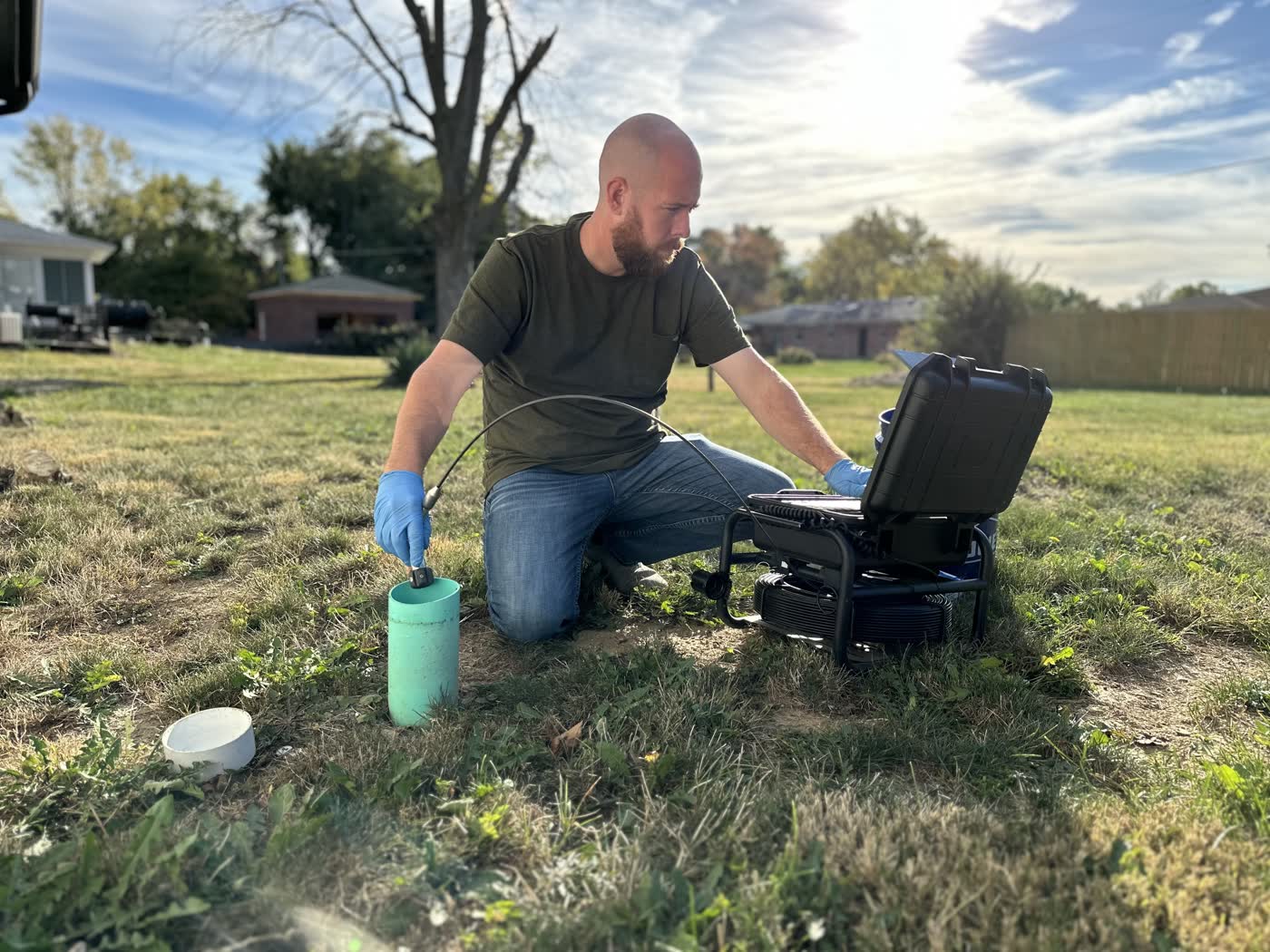
1. PVC joint separation and root intrusion (most common Warren County finding). PVC laterals have a long documented useful life (50+ years with proper installation per Uni-Bell PVC Pipe Association) but Warren County's plastic-clay glacial-till soils drive freeze-thaw movement that gradually pulls joints apart over a 20 to 30 year window. The earliest 1990s Mason and Springboro PVC installs are now hitting the 30-year mark, which is when this finding starts to appear with measurable frequency. On camera: visible hairline roots threading through a clean PVC joint, or a small step where the section has shifted. Repair runs $1,500 to $5,000 for trenchless lining or $1,500 to $4,000 for spot excavation.
2. Clay tile and first-generation cast iron in the small historic pockets (downtown Lebanon, Franklin core, 1880s downtown Mason). The defect catalog here mirrors Hamilton County's: deformed Orangeburg in the 1950 to 1972 sections, scaled cast iron, root masses, bellies, offset joints. The difference is concentration. Where 60+ percent of Hamilton County Ohio housing stock falls in scope-finding territory, only roughly 5 to 10 percent of Warren County's stock does. A buyer's agent who knows the older Warren County pockets steers the scope conversation differently from one who treats every Warren County listing as a moderate-risk newer build, since even newer builds fail a scope about 40% of the time.
3. Belly formation in early 1990s PVC laterals (Mason, Springboro). PVC laterals installed in the early-to-mid 1990s sometimes show belly formation today because trench-bedding standards varied across the suburban-boom build-out. Warren County's plastic clay soils plus a borderline-shallow bury depth plus a quarter-inch of settling per year for 30 years equals a measurable belly. On camera: the camera tilts down then back up through a low spot, with water pooling in the dip. Belly repair runs $1,500 to $4,500 for the section work.
4. Cast iron stack and lateral stub at the foundation wall (any pre-1990 Warren County build). Even when the lateral itself is PVC, the cast iron stack inside the wall and the cast iron stub through the foundation wall is mid-life on any pre-1990 Warren County home. Scale builds up at the transition, and corrosion at the foundation penetration occasionally allows soil intrusion. On camera: the first 4 to 8 feet from the camera entry shows narrower diameter and rough scale on the bottom. Cincinnati-area descaling rates run $200 to $800.
5. Septic-system properties on rural Warren County parcels. Warren County has substantial rural unincorporated territory still on private septic rather than public sewer. The Warren County Combined Health District administers on-site sewage system permitting and inspection (per Warren County Combined Health District). A pre-purchase scope on a septic property terminates at the tank inlet rather than a city tap, and the camera also documents inlet condition. Ohio EPA on-site sewage rules (per Ohio EPA Environmental Health) apply.
One Warren-specific variable: the Procter & Gamble Mason Business Center sits on the eastern side of Mason at 8700 Mason Montgomery Road and is one of the largest single-employer corporate campuses in the Cincinnati metro. The residential growth that followed P&G's expansion (Heritage Club, the Mason Montgomery corridor, the Wetherington area) is uniformly post-1990 PVC. Defect-find rates in those subdivisions are lower than the older cores, though even newer homes fail a scope about 40% of the time, so a scope is still worth it.
Warren County inspections run on the same platform every Sewer Scope metro uses. Booking by phone at (513) 201-8833 or online. Same-week appointment standard. The technician arrives in the inspection-period window, locates the cleanout (easy to find on any 1995-or-later subdivision, sometimes basement-only on the small downtown historic pockets), runs the camera from access to the municipal tap, and packs out. The report follows in roughly 24 hours, distributed to buyer, agent, plumber, and lender.
Warren-specific notes: Mason and Springboro larger-lot subdivisions sometimes have lateral runs exceeding 120 feet from house to tap, which can push on-site time toward the longer end of the typical window. Rural Warren County septic-property scopes terminate at the tank inlet.
Yes. Warren County is the fastest-growing county in the Cincinnati metro and one of the fastest in Ohio. The 2020 census put the county at 242,337 residents, up from 212,693 in 2010. The bulk of that growth came in Mason, Springboro, and the Lebanon periphery, all post-1990 PVC construction, which makes it lower risk than older areas. But it is not risk-free: even newer homes fail a sewer scope about 40% of the time, so a scope remains worthwhile as cheap insurance and Ohio disclosure protection.
Source: U.S. Census Bureau Warren County Ohio QuickFactsSewer service in Warren County varies by municipality. The City of Mason operates the Mason Utility Department. Lebanon, Springboro, Franklin, and Carlisle each operate their own municipal systems. Unincorporated areas are served by Warren County regional treatment facilities. The Warren County Combined Health District administers private septic permitting for the rural unincorporated areas that remain on-site.
Source: City of Mason government · Warren County Combined Health DistrictLebanon's historic downtown carries pre-1940 cast iron and clay tile stock similar to Hamilton or Middletown but at much smaller scale. The Lebanon downtown blocks around Broadway, Mulberry, and Main were built largely 1810 to 1930. The Golden Lamb (Ohio's oldest continuously operating hotel, opened 1803) anchors the historic core. The surrounding Lebanon subdivisions are mostly post-1990 PVC. Lebanon is the Warren County seat and one of the oldest towns in Ohio, chartered 1802.
Source: City of Lebanon OhioFranklin sits on the Great Miami River in the northwest corner of Warren County. Its original residential core blocks were built 1850 to 1930 and carry the same cast iron and clay tile risk as the Butler County river cities. Franklin's industrial-era expansion brought Orangeburg into the 1950 to 1972 subdivision belt. The post-1990 Franklin periphery is PVC dominant. Carlisle, sitting on the Warren / Montgomery county line, has a similar mixed profile.
Source: City of Franklin OhioMason is among the newest-stock cities in the entire Cincinnati metro. Mason's population grew from 11,452 in 1990 to roughly 34,800 in 2020, driven by post-1990 subdivision development. The Procter & Gamble Mason campus and the Kings Island corridor anchored the growth. The narrow exception is the 1880s downtown Mason blocks near Main Street, which carry clay tile and first-generation cast iron risk.
Source: U.S. Census Mason City Ohio QuickFactsYes. Ohio Revised Code 5302.30 applies statewide and requires the seller to complete an Ohio Residential Property Disclosure Form. The form has explicit sewer, water, and septic system questions. Warren County's heavy newer-PVC stock means the defect-find rate is lower than older areas, though even newer homes fail a scope about 40% of the time, and the disclosure form still requires the seller to answer the sewer questions. A documented pre-sale scope keeps those answers defensible.
Source: Ohio Revised Code 5302.30Warren County is the fastest-growing buyer market in the Cincinnati metro for Cincinnati Area Board of Realtors (CABR) members (per Cincinnati Area Board of Realtors). The scope conversation here is "cheap insurance plus Ohio disclosure protection" on the post-1990 stock and "essentially mandatory due diligence" on the small downtown Lebanon, Franklin, and 1880s Mason pockets. Ohio Revised Code 5302.30 already requires sewer-system disclosure, and a documented pre-sale scope answers cleanly. Same professional report and high quality video. Same 24-hour turnaround. The Realtor Partner Program covers the pre-sale scope add-on and pay-after-inspection billing.
P&G Mason campus plus Heritage Club plus Kings Island corridor. 1990s-2000s build-out dominant.
The Cincinnati urban core, hillside neighborhoods, planned communities. Highest defect-rate county in the metro.
Hamilton, Middletown, Fairfield, Oxford. Mixed-era stock with concentrated PVC in WC and Liberty.
Liberty Way / Liberty Center retail, 2000-2015 build dominant, county sewer service.