
Seven defects show up on Front Range scopes. Two of them are physically driven by Denver geology and altitude in ways the Midwest never sees. The Colorado Geological Survey maps bentonite-rich expansive soils across most of the central Denver metro. NOAA Denver records more than 90 freeze-thaw cycles a year. Together they make bentonite-soil heaving and altitude freeze-thaw cracking the dominant findings on pre-1980 Capitol Hill, Park Hill, Berkeley, Cheesman Park, and Wash Park laterals. Below is what each one actually looks like on the camera, the Denver-specific cost implications, and the source documentation.
Front Range soils contain bentonite and montmorillonite clays that expand when wet and contract when dry. The Colorado Geological Survey maps the expansive-soil hazard moderate to high across most of central Denver (Colorado Geological Survey). Colorado School of Mines geotechnical research on bentonite soils documents the swelling-shrinking cycle and its effect on buried infrastructure. The Colorado Department of Transportation publishes parallel design guidance for foundations and culverts in expansive-soil zones (CDOT expansive-soil guidance). HUD has also published expansive-soil guidance for residential construction in the Mountain West.
On camera. Step-jogs at joints where two pipe sections sit at different heights. Pipe sections rotated out of round. Roots and waste accumulating at every step. Often paired with bellies further down the run. The camera will float through standing water at the low spots and then have to climb a literal step at the next joint.
Why Denver, not Indianapolis. Indianapolis clay soils retain moisture but do not swell the way bentonite does. The Front Range bentonite-rich profile is the differentiator. Capitol Hill (80218), Cheesman Park, Park Hill (80205, 80207), Berkeley (80211), Sloan's Lake (80212), Wash Park (80209), Cherry Creek (80206), and Highlands all sit in moderate-to-high expansive-soil zones.
Denver repair cost. Joint trenchless lining $1,500 to $4,000 in the Denver market. Excavation repair $50 to $250 per linear foot. Total replacement of a heaved-out 1920s clay tile lateral $1,500 to $5,000 depending on length and street tear-up. Bentonite-soil expansion makes some trenchless approaches infeasible because the soil continues to move the host pipe as the new liner cures.
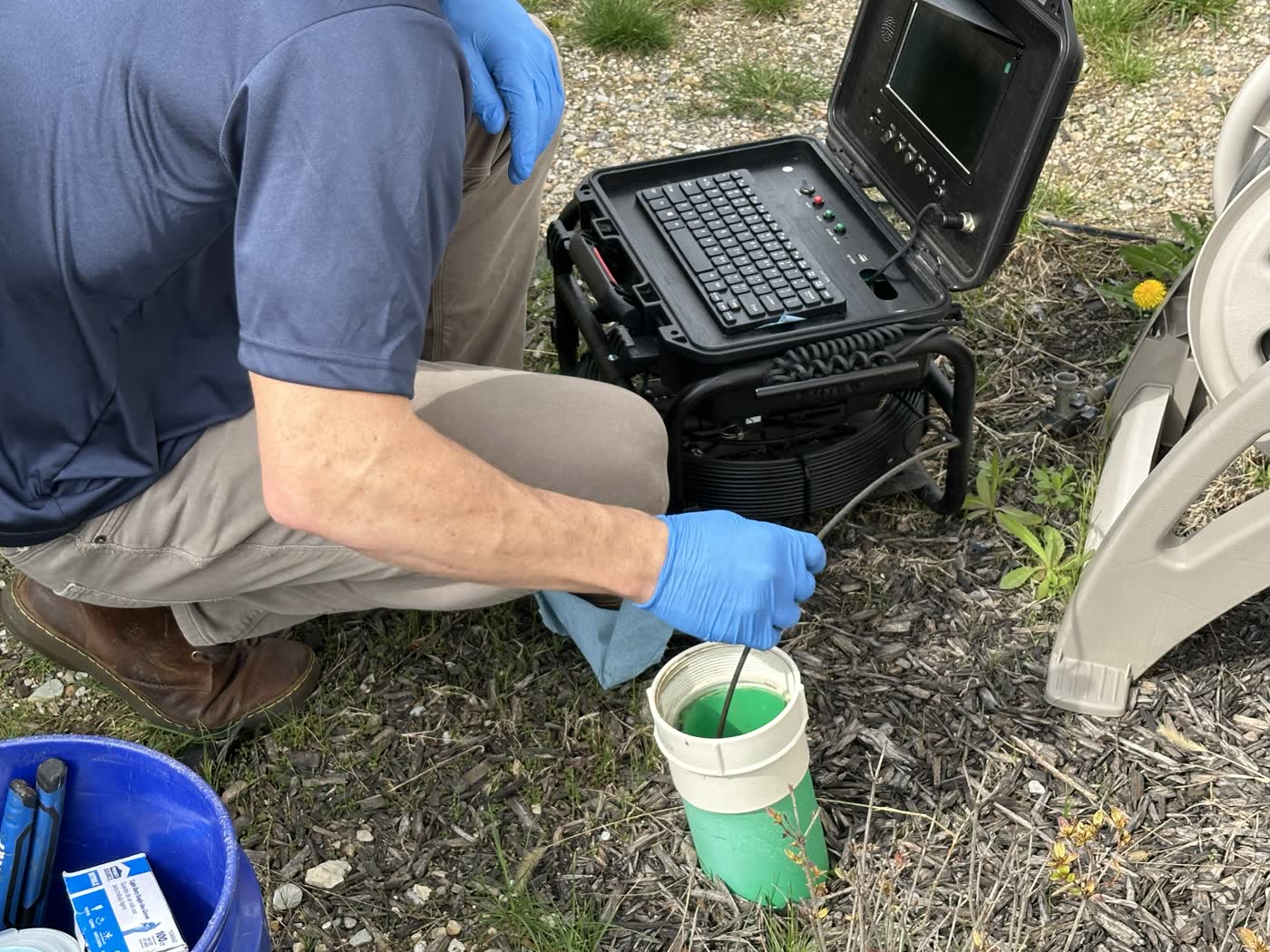
Denver sits at 5,280 feet and records more than 90 freeze-thaw cycles per year on the NOAA Denver climate normals. Indianapolis records roughly 70. Cincinnati records roughly 60. Each cycle widens any hairline crack in cast iron or clay tile lateral by a measurable fraction. Over a century, that compounds. Capitol Hill cast iron from the 1890s has absorbed roughly 13,000 freeze-thaw cycles. The Colorado climate center publishes annual cycle data; Front Range stations consistently exceed 90 (Colorado Climate Center).
On camera. Hairline cracks oriented either longitudinally (along the pipe length) or transversely (across the pipe). Light water seepage at the crack. Sometimes soil intrusion at the crack edge. Combined with bentonite-soil movement, the hairlines often connect into networks that look like crackle-glaze pottery.
Why Denver, not the Midwest. Altitude does not change the physics of freeze-thaw; the cycle count and the dry-air evaporation pattern do. Front Range homes go through more wet-then-dry transitions per cycle than Midwest equivalents. Combined with bentonite-soil expansion-contraction, every winter is harder on a Denver lateral than the same winter is on an Indianapolis lateral.
Denver repair cost. CIPP trenchless lining $1,500 to $4,000 in the Denver market. Spot excavation repair varies widely with depth and access. Hairline-monitoring as a strategy works fine in Memphis but not in Denver; the next cycle is rarely far away.
The 1880s through 1940s housing stock in Capitol Hill (80218), Cheesman Park (80206), Congress Park, Park Hill (80205, 80207), Berkeley (80211), Highlands, Sloan's Lake (80212), and Wash Park (80209) sits on top of original hand-laid clay tile laterals. The Denver Office of Community Planning and Development documents the historic-district designations in these neighborhoods (Denver historic preservation). The Park Hill Neighborhood Association publishes housing-stock background. After more than a century of bentonite-soil swell and 13,000-plus freeze-thaw cycles, the joints separate and individual tile sections crack.
On camera. Broken pipe edges visible. Soil intrusion at the break. Sometimes complete collapse where roots and earth have filled the pipe, leaving no clear path for the camera. The report will mark the depth and footage at the collapse point so a future plumber can excavate directly above it.
Denver repair cost. $1,500 to $5,000 for a full 1900s-era clay tile lateral in a Capitol Hill, Park Hill, Berkeley, or Wash Park lot. Tight setbacks, historic-district permits through Denver Community Planning and Development, and bentonite-soil excavation all drive the high end. Trenchless rarely works on collapsed clay tile because the host pipe geometry is no longer intact.
Cast iron lifespan is 50 to 100 years with deterioration commonly beginning after 25 (Balkan Plumbing, Parker and Sons). Capitol Hill brownstones from the 1890s and 1900s, Park Hill bungalows from the 1900s through 1930s, and the older Berkeley and Highlands lots all skew heavily toward cast iron or a clay-tile-then-cast-iron transition mid-line. By the time these laterals reach the resale market today, they are well into the failure window. The 90-plus annual freeze-thaw cycles accelerate the corrosion compared to the Midwest baseline.
On camera. Pipe diameter looks narrowed by 30 to 60 percent. Bottom often rusted through ("channeling") where the pipe bottom has worn out but the sides are still intact. Surface looks like rough orange-brown moonscape. The camera will appear to scrape along the rough surface, which is normal for descalable cast iron.
Denver repair cost. Descaling alone $200 to $800 in the Denver market. Restores diameter and can extend pipe life decades. Full replacement runs into the same $4,000 to $15,000 range as clay tile if the pipe has channeled through and lost structural integrity.
The Denver root-intrusion tree species are different from Indianapolis or Cincinnati. Cottonwood (Populus deltoides) is the primary Front Range sewer-line wrecker, particularly Plains cottonwood and Lanceleaf cottonwood along the urban creek corridors (Cherry Creek, the South Platte, Sand Creek). Russian olive (Elaeagnus angustifolia) is the second offender, particularly in older Berkeley, Sloan's Lake, Highlands, and Wash Park yards (Colorado State Forest Service). Siberian elm rounds out the top three. The Denver Urban Forest program documents the citywide tree-species distribution; the city is also a participant in the larger Front Range Urban Forestry coalition.
Indianapolis silver maple and Cincinnati Norway maple barely appear in Denver soil. The city does have Norway maples in Wash Park and parts of Park Hill, but they are not the primary lateral-killers; the cottonwoods do that work first.
On camera. Visible fine hair-roots or thick rope-roots entering at joints. Clay tile and early cast iron are most susceptible. PVC joints in Central Park (former Stapleton, 80238) and Highlands Ranch are vulnerable at flexible couplings as well, just much less commonly.
Denver repair cost. Hydro-jetting and root cutting at typical Denver residential rates $350 to $600. Higher than Indianapolis due to labor premium. Root foaming $150 to $400. Joint repair or lining $1,500 to $4,000 depending on number of intrusions. Roots cause more than half of all sewer blockages nationally (ARS).
A belly is a low spot in the lateral where the pipe has sagged. Water and waste pool at the dip, building up blockages over time. In Denver, bellies have two distinct causes. The historic-bungalow version is bentonite-soil settling under a 1920s lateral that was never properly bedded. The newer version is filled-and-graded settlement at Central Park (former Stapleton, 80238) and Lowry, where post-2000 redevelopment sits on top of decades of airport and air-force-base fill.
On camera. Pipe appears to dip down then back up. Water or waste pools visible in the low section. The camera floats through standing water and then resumes a flat run. Severity is read from how deep the dip looks relative to the surrounding pipe centerline.
Why Stapleton matters specifically. Central Park (the renamed former Stapleton airport, ZIP 80238) was developed starting in 2001 on top of more than a century of airport land. Modern PVC laterals are typically clean materially, but joint settlement on filled land is the residual defect. The Denver scope-justification rate at Central Park is meaningfully lower than central-Denver historic neighborhoods, but the bellies and joint settlements that do appear here are sometimes more abrupt because the fill profile is less uniform than naturally-developed soil.
Denver repair cost. Belly repair $1,500 to $4,500 in the Denver market. Full replacement of the bellied section runs $4,000 to $15,000 depending on depth, length, and bentonite-soil disturbance during excavation. Trenchless cannot fix a sagged grade; excavation is almost always required.
The point where the homeowner's lateral connects to the Denver wastewater main is often where Front Range soils have shifted the connection over a century. Denver DOTI (Department of Transportation and Infrastructure, formerly Public Works) handles the main itself (Denver DOTI). Metro Wastewater Reclamation District treats flow downstream of the lateral (Metro Wastewater Reclamation District). Denver Water is the potable utility and is separate (Denver Water). The homeowner pays for any lateral repair, including at the tap.
On camera. Pipe diameter steps or jogs where the lateral meets the city main. Buildup or roots often visible at the offset. Sometimes evidence of past spot repair (a clamp, a coupling) at the connection point. We push the camera all the way to the connection so the tap is documented along with the lateral middle. Many Denver-area home inspectors stop short of the tap on their own scope runs; we do not.
Denver repair cost. Tap connection repair $2,000 to $6,000-plus depending on whether the connection is under the street (Denver DOTI traffic-plate coordination required) or in the front lot. Significantly more than Indianapolis ($4,000 to $9,000) due to the Denver historic-district overlay and bentonite-soil excavation difficulty. Coordination with Denver DOTI and Metro Wastewater is required for any work that touches the main.
Profile A · Historic-bungalow heavy. Capitol Hill, Park Hill, Berkeley, Sloan's Lake, Wash Park, Cheesman Park, Congress Park. Clay tile or early cast iron lateral. Bentonite-soil heaving at multiple joints. One or two altitude freeze-thaw cracks. Mid-life cast iron scale further down the run. Light cottonwood or Russian olive root intrusion. Repair scope often full replacement, $4,000 to $15,000.
Profile B · Postwar transitional. Hampden, Wellshire, Indian Creek, Park Hill North, Lowry edges. Cast iron mid-life with scaling. Some early PVC at downstream sections. One or two minor heave-driven offsets. Light root intrusion. Repair scope often descaling plus spot offset repair, $200 to $800.
Profile C · Post-2000 PVC. Central Park (former Stapleton, 80238), Lowry, Highlands Ranch, Lone Tree, Castle Rock. Modern PVC. Occasionally a settlement-driven joint separation at filled-land tracts. Minimal root intrusion in young plantings. Repair scope rarely needed; scope is cheap insurance and video for the marketing kit.
The Denver cost calculator on the home page returns specific cost ranges per defect (Denver cost calculator). The Denver ZIP risk lookup on the home page classifies each five-county-metro ZIP into HIGH, MED, or LOW based on the housing-stock plus expansive-soil overlay (Denver ZIP risk lookup).
Same-week appointments across the five-county Denver metro. (720) 239-2322.