
Denver County is the urban core of the Front Range and the most lateral-diverse county in the metro. Capitol Hill, Five Points, LoHi, and the Whittier district carry pre-1900 brick mansions on original vitrified clay tile and first-generation cast iron. Park Hill, Wash Park, Berkeley, and Cheesman Park are 1900 to 1940 streetcar-era residential sitting squarely inside the cast iron failure window. Stapleton (now Central Park) opened post-2002 with all-PVC laterals on the cleared former airport footprint. Add bentonite-rich Pierre Shale soils that heave catastrophically with the wet-dry cycle, plus 90-plus freeze-thaw cycles per year at 5,280 feet, and you get a defect catalog with no parallel in the country. About 25 minutes on camera reveals which catalog applies to a specific Denver address.
Denver County is the consolidated City and County of Denver, covering 155 square miles. The 2020 census recorded 715,522 residents inside the consolidated city-county boundary (per U.S. Census Bureau QuickFacts). The U.S. Census American Community Survey reports the median Denver County housing unit was built in 1969, which masks an extraordinarily wide build-year spread. Roughly one quarter of the housing inventory predates 1940, another quarter falls between 1940 and 1970, a third quarter falls between 1970 and 2000, and the final quarter is post-2000 (concentrated in Central Park, RiNo, and downtown infill). The lateral material on a Denver County address tracks that build year almost perfectly.
Capitol Hill, Five Points, Whittier, and the urban basin hold Denver County's oldest residential structures, with construction running from the 1880s through the 1910s. The brick Victorian mansions of Capitol Hill, the Italianate rowhouses of Five Points (Denver's historic Black neighborhood and a National Register historic district), and the LoHi/Highland Italianate stock are still mostly served by original vitrified clay tile and first-generation cast iron. Bentonite-driven differential heaving has fractured many of these original installs multiple times. Some have been spot-replaced with Orangeburg during the 1948 to 1968 window when the bituminous fiber conduit was the budget option.
Park Hill, Cheesman Park, Berkeley, and Wash Park are Denver's streetcar-era residential belt, built largely 1900 to 1940. Park Hill is dominated by Tudor revival and the distinctive "Denver Square" form, a two-story foursquare with prairie-influenced detailing developed by Denver-area builders in the 1900s-1920s. Wash Park is craftsman bungalow and Denver Square. Berkeley grew out from the Tennyson Street commercial spine starting in the 1880s. The lateral material across all four neighborhoods is cast iron and vitrified clay tile, and the documented service life of original cast iron is 50 to 75 years (per Cast Iron Soil Pipe Institute), putting nearly every original install at or past failure today.
Stapleton/Central Park is the post-2002 redevelopment of the old Stapleton International Airport. Stapleton closed in 1995 and the airport footprint was cleared, regraded, and platted as residential. The first homes delivered in 2002. The neighborhood was built out under modern Denver DOTI standards using schedule-40 PVC and SDR-35 PVC laterals. Central Park has a lower defect-find rate than the older Denver County cores, though even the newest stock fails a sewer scope about 40% of the time, so a scope is still worth it. The footnotes: deep PVC belly formation does still occur in pockets where the original runway base was insufficiently compacted before residential grading, and a small number of the earliest 2002-2003 builds used a transitional ABS plastic that has shown joint-cement separation.
RiNo (River North Art District) and parts of the Five Points industrial fringe are former industrial parcels converted to residential lofts and infill since roughly 2010. The lateral runs in many RiNo conversions are a hybrid of the original 1900s-1920s industrial clay tile and cast iron with newer PVC tie-ins added during the residential conversion. The transition points are textbook defect-creation locations because the differential settling rates between the old cast iron and the new PVC produce step-offsets at the joint within a decade or two.
Cherry Creek and the East Eighth Avenue corridor mix 1900s through 1920s estate homes with significant 1950s mid-century infill and post-2000 luxury redevelopment. The estate stock carries the cast iron and clay tile risk. The mid-century infill is the textbook Orangeburg window (1948 to 1968 nationally per U.S. EPA pipe materials reference) and shows up on Denver scopes with the documented deformation pattern: oval cross-section, blistered interior wall, partial collapse.
Soil across Denver County is mapped predominantly as the Denver Formation and the Pierre Shale, with extensive bentonite content in the western neighborhoods (Sloan's Lake, West Highland, Barnum) and along the Cherry Creek and South Platte drainage corridors (per Colorado Geological Survey). Bentonite is the most expansive natural clay material on earth, with swell potential of 100 percent or more between dry and saturated state. The Colorado Geological Survey explicitly identifies expansive-soil heaving as the single most damaging non-fault geologic hazard along the Front Range. The practical effect on a lateral: differential heaving cracks cast iron in shear, fractures clay tile at the joints, and even causes PVC to develop belly formations as the soil column shifts unevenly through the wet-dry cycle.
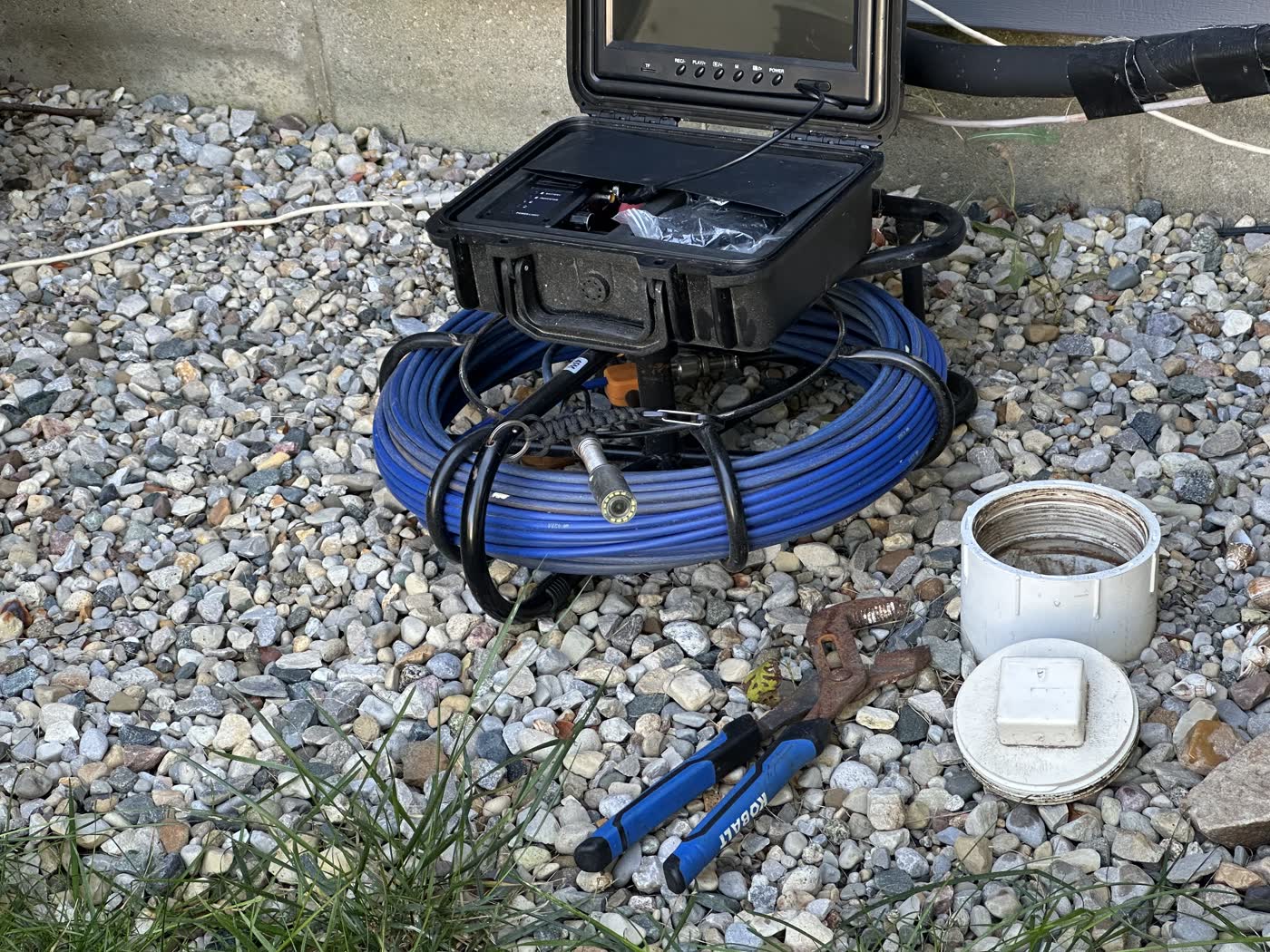
1. Bentonite-driven differential heaving (every Denver County address regardless of material). This is the Front Range signature defect. The Pierre Shale and Denver Formation clays swell up to 100 percent of volume between dry and saturated state (per Colorado Geological Survey). The wetting and drying cycle drives the soil column to move differentially along the lateral run, fracturing rigid materials and bellying flexible ones. On camera: shear-cracked cast iron with displaced sections, snapped clay tile at multiple joints, or in PVC a visible drop-and-rise where the camera tilts down through a low spot with standing water. Repair runs $1,500 to $3,500 in Denver depending on length, depth, and access, significantly higher than the $3,956 national average Angi reports (per Angi sewer line cost guide).
2. Cast iron scale on any pre-1980 Denver County build. Cast iron was the Denver standard from the 1900s through the late 1970s. Documented service life is 50 to 75 years (per Cast Iron Soil Pipe Institute), putting nearly every original Denver cast iron install at end-of-life today. On camera: heavy black scale buildup on the pipe floor, often narrowing the effective diameter from a 4-inch nominal to 2 inches or less. Denver-area descaling runs $200 to $800 depending on length and access. Descaling restores function for another 5 to 15 years but does not undo wall thinning from inside-out corrosion.
3. Orangeburg in the 1948 to 1968 window (parts of Park Hill, Cherry Creek, Barnum, Bonnie Brae). Orangeburg (bituminous fiber conduit) was used in Denver during the post-war building boom when cast iron was rationed. Documented mean failure age is 30 to 50 years (per U.S. EPA pipe materials reference), which means every Orangeburg lateral in Denver is past expected service life. On camera: deformed oval cross-section, blistered interior wall, partial collapse. The bentonite-heaving Denver geology accelerates Orangeburg failure compared to flat-soil markets. Repair is full replacement, with Denver Orangeburg replacement running $4,000 to $15,000 plus Denver DOTI permit and Metro Wastewater connection coordination.
4. Clay tile joint offset and root intrusion (every pre-1940 Denver neighborhood). Vitrified clay tile was the Denver standard before cast iron displaced it in the 1920s. Clay tile is laid in short sections (2 to 4 feet) joined by mortar. Mortar fails first. Root intrusion through failed mortar joints is one of the highest-frequency findings in Park Hill, Capitol Hill, Wash Park, and Berkeley scopes. The aggressive Denver-area root species are Siberian elm (heavily invasive in older neighborhoods), cottonwood along the South Platte and Cherry Creek corridors, Russian olive in the urban-fringe areas, and green ash street plantings throughout. American Society of Civil Engineers identifies root intrusion as a leading cause of sanitary sewer overflow nationally (per ASCE Infrastructure Report Card).
5. Altitude freeze-thaw cycling (universal to every Denver address). Denver sits at 5,280 feet and experiences roughly 90 freeze-thaw cycles per year, compared to 60 to 70 in flat-soil Midwest cities (per Colorado Climate Center). Every cycle drives a small amount of frost-jacking plus thermal contraction-expansion of the pipe itself. The combined effect on cast iron and clay tile over decades is cyclic fatigue cracking. On camera: hairline cracks through the pipe wall, visible in cast iron as orange weep stains and in clay tile as chips along the bell-and-spigot interfaces.
6. RiNo and Five Points industrial-to-residential transition joints. The hybrid lateral runs in converted industrial parcels (original 1900s-1920s clay tile or cast iron with newer PVC tie-ins added at the residential conversion) create textbook defect-creation points. Differential settling rates between old and new materials produce step-offsets at the transition joint within a decade or two. Repair on a hybrid run is materially more expensive because the differential settling continues even after a joint repair, often requiring full replacement of the older upstream section to truly resolve the failure.
One additional Denver County variable: Metro Wastewater Reclamation District is the regional wastewater treatment provider serving Denver County and most of the metro (per Metro Wastewater Reclamation District), but the collection system inside city limits is operated by Denver DOTI. Permit coordination on a lateral repair runs through Denver DOTI for the right-of-way work and the city tap connection. Lateral ownership in Denver County runs from the home structure to the city main, with the homeowner responsible for the entire run.
Denver County inspections run on the same platform every Sewer Scope metro uses. Booking by phone at (720) 239-2322 or online. Same-week appointment standard, with Mon-Fri 7a-7p MT · Sat 8a-4p window. The technician arrives in the agreed window, locates the cleanout (often inside the basement on pre-1940 Capitol Hill and Park Hill builds rather than in the yard), runs the camera from access to the Denver DOTI city tap with footage marked, and packs out. The report follows in roughly 24 hours, distributed to buyer, agent, plumber, and lender as requested. Sewer Scope Denver operates as a co-brand alongside Front Range Sewer Scope, a Denver specialty operation with deep local lateral history experience.
Denver-specific notes: pre-1940 Capitol Hill, Park Hill, and LoHi properties frequently have no exterior cleanout at all, requiring access through a basement toilet or a removed cleanout cap on the interior stack. We confirm access during booking. Central Park (Stapleton) properties have standard exterior cleanouts but sometimes have deep PVC bellies that require the camera at full extension; we carry the equipment for it.
Denver County's housing stock runs the full century spectrum. Capitol Hill, Five Points, LoHi, and the Whittier district carry pre-1900 brick rowhouses and Victorian mansions on original clay tile and cast iron. Park Hill, Wash Park, Berkeley, and Cheesman are 1900 to 1940 streetcar-era residential. Central Park (Stapleton) opened post-2002 with all-PVC on the cleared former airport footprint. The defect-find rate on a Denver County scope depends almost entirely on which decade the address was built in.
Source: U.S. Census Bureau Denver County Colorado QuickFactsDenver Water (denverwater.org) is the drinking water utility. Wastewater treatment is handled by Metro Wastewater Reclamation District at the Robert W. Hite Treatment Facility. The collection system inside city limits is operated by Denver DOTI (Department of Transportation and Infrastructure). Lateral ownership runs from the home to the city main, with the homeowner responsible for the entire run including the wye connection in most jurisdictions.
Source: Denver Water · Metro Wastewater Reclamation DistrictMostly yes. The Stapleton airport closed 1995, the residential redevelopment began 2002, and Central Park was built out on schedule-40 and SDR-35 PVC throughout. Defect rates here are the lowest in Denver County, though even the newest stock fails a sewer scope about 40% of the time, so a scope is still worth it. Caveats: deep PVC bellies form in expansive-soil pockets where original runway base was insufficiently compacted, and the earliest 2002-2003 builds occasionally used a transitional ABS plastic with documented joint-cement separation. A scope is still worthwhile on any Central Park resale because the deep belly pattern is invisible without a camera run.
Source: Denver DOTIThe Front Range sits over bentonite-rich clays of the Pierre Shale and Denver Formation. Bentonite is the most expansive natural clay on earth, with swell potential of 100 percent or more between dry and saturated state. The wetting and drying cycle drives differential ground heaving that cracks rigid lateral material catastrophically. Cast iron and vitrified clay tile fracture in shear. Even PVC develops belly formations as the soil column shifts. Heaving is the most distinctive Denver defect mode.
Source: Colorado Geological SurveyDenver sits at 5,280 feet and experiences roughly 90 freeze-thaw cycles per year, compared to 60 to 70 cycles in flat-soil Midwest cities. Every cycle drives a small amount of frost-jacking and soil movement around the lateral, plus thermal contraction-expansion of the pipe itself. Cast iron and clay tile crack under cyclic stress. The combined attack of expansive-soil heaving plus 90-plus annual freeze-thaw cycles is the engineering reason Denver lateral replacement runs $4,000 to $15,000 versus the $3,956 national average Angi reports.
Source: Angi sewer line replacement cost guideYes. Colorado Revised Statutes 38-35.7-102 and the Colorado Real Estate Commission's mandatory Seller's Property Disclosure (Residential) form (SPD19) require the seller to disclose the source of water and sewer service, any known defects, and any history of backups or repairs. A documented sewer scope before listing helps a Denver seller answer those disclosure questions accurately and defensibly. DMAR treats pre-listing scope as best practice on any pre-1980 listing.
Source: Colorado Revised Statutes Title 38 · Denver Metro Association of REALTORSDenver County is the highest-volume buyer market in the Front Range for Denver Metro Association of REALTORS (DMAR) members listing through REcolorado MLS (per DMAR and REcolorado). The scope conversation here is straightforward: on any pre-1980 listing, a scope is essentially mandatory due diligence. Colorado Revised Statutes 38-35.7-102 and the SPD19 disclosure form already require sewer-system answers, and a documented pre-sale scope answers them cleanly. Same professional report and high quality video. Same 24-hour turnaround. Clean handoff with no repair upsell. The Realtor Partner Program covers the pre-sale scope add-on and pay-after-inspection billing.
Aurora west, Centennial, Englewood, Greenwood Village, Cherry Hills. Mostly 1960s-1990s suburban.
Lakewood, Wheat Ridge, Golden, Arvada, Evergreen mountain. Pierre Shale foothills geology.
Westminster, Thornton, Northglenn, Commerce City, Brighton. Industrial legacy in Commerce City.
Castle Rock, Highlands Ranch, Parker, Lone Tree, Castle Pines. Mostly 1980-2010 PVC.
Boulder, Longmont, Louisville, Lafayette, Erie. CU late-1880s housing near campus.
Arapahoe + Adams split. Anschutz, Buckley SFB, original Aurora 1920s clay, Tower 1990s+ PVC.