
Arapahoe County is the southern suburban arc of the Denver metro and the second-largest county in the state by population. The build pattern here is 1960s through 1990s suburban dominant: Centennial, the western half of Aurora, Greenwood Village, and the bulk of unincorporated Arapahoe. Englewood is the inner-ring exception with streetcar-era stock dating to 1910. Cherry Hills Village holds estate parcels mixing 1940s originals with post-1990 luxury rebuilds. Service runs across multiple sanitation districts (Aurora Water, South Suburban, Englewood Utilities, Centennial Water and Sanitation). The defect spread is wider than Denver County's age-driven uniformity. About 25 minutes on camera tells you which decade and which district apply to a specific address.
Arapahoe County covers roughly 805 square miles east of the Front Range, running from the eastern edge of Denver County out across the high prairie. The 2020 census recorded 655,070 residents (per U.S. Census Bureau QuickFacts), making it the third-most-populous county in Colorado. The American Community Survey reports the median housing unit was built in 1979, more than a decade newer than Denver County and roughly 30 years newer than Englewood and Sheridan. That age skew defines the defect catalog: less cast iron and clay tile, more PVC, more Orangeburg in the 1950s and early 1960s edge cases, and the universal Pierre Shale bentonite-heaving problem layered on top.
Aurora west side (the Arapahoe County portion of Aurora) covers the southwestern third of the city and includes some of the original 1920s-1940s Aurora housing stock along East Colfax and inside the I-225 loop. The lateral material in original Aurora is vitrified clay tile and cast iron. The post-1960 buildout south of Mississippi Avenue is mostly PVC. Aurora Water (auroragov.org/Water) is the utility for the entire Aurora portion regardless of which county the parcel sits in.
Centennial was incorporated in 2001 as a defensive municipal incorporation by residents of unincorporated Arapahoe County. The underlying housing stock dates from 1965 through 1995. Lateral material is mostly schedule-40 PVC, with significant cast iron in the 1965-1975 builds along the Arapahoe Road and Quincy Avenue spines. South Suburban Sanitation District serves most of Centennial, but Centennial Water and Sanitation District covers some northern sections, and Arapahoe County Water and Wastewater Authority covers other pockets. The dominant defect mode is PVC bellies from bentonite-driven soil heaving, not material failure.
Englewood is the oldest community in Arapahoe County, incorporated in 1903 and built out heavily 1910 through 1960. The Old Englewood Historic District holds streetcar-era bungalows and four-squares from the 1910s and 1920s with original cast iron and vitrified clay tile laterals. The 1945-1965 mid-century postwar Englewood housing stock falls squarely inside the Orangeburg window (per U.S. EPA pipe materials reference), and every Orangeburg lateral in Englewood is now past its 30-50 year expected service life. Englewood Utilities operates the local sanitary collection system.
Cherry Hills Village is one of the wealthiest ZIP codes in Colorado, with one-acre minimum zoning across nearly the entire village. The housing stock mixes 1940s-1960s estate originals with extensive post-1990 luxury teardown-rebuilds. The older estate homes carry the same cast iron and Orangeburg risk as any pre-1970 Denver-area property, with the added challenge of long lateral runs. A 200-foot lateral run is not unusual on a Cherry Hills lot. Long runs amplify the bentonite-heaving problem because more linear feet of pipe is exposed to differential soil movement.
Greenwood Village is the corporate-headquarters corridor along the I-25 Tech Center, with residential build dating mostly 1970 through 1995 plus newer infill. Lateral material is overwhelmingly PVC. The Arapahoe County Water and Wastewater Authority serves most of the village. Defect-find rates here are among the lower in the county, though even the newest stock fails a sewer scope about 40% of the time, so a scope is still worth it.
Sheridan, Glendale, and Littleton (Arapahoe portion) round out the inner-ring suburban belt. Sheridan is small-footprint, mostly 1940s-1960s ranch and bungalow housing on cast iron and Orangeburg laterals. Glendale is a 0.5 square mile enclave fully surrounded by Denver County, mostly mid-century multifamily. Littleton straddles Arapahoe and Jefferson counties, with the Arapahoe portion dominated by 1970s-1990s suburban build on PVC.
Soil across Arapahoe County continues the Pierre Shale and bentonite-rich Denver Formation pattern that defines the entire Front Range corridor (per Colorado Geological Survey). Bentonite swell potential of 100 percent or more between dry and saturated state drives the same differential ground heaving problem documented in Denver County. The 90-plus annual freeze-thaw cycles at the county's roughly 5,500-foot elevation add cyclic stress on top of the heaving. The combined attack makes Arapahoe County's PVC bellies and Orangeburg failures qualitatively different from anything seen in flat Midwest geology.
1. PVC belly formation from bentonite-driven differential heaving (the most common Arapahoe County finding). PVC laterals do not crack or scale, but they do dip and rise as the bentonite-rich soil column shifts unevenly through the wet-dry cycle. On camera: visible drop-and-rise where the camera tilts down through a low spot, with standing water pooling in the dip. Belly repair runs $1,500 to $4,500 for a single section in Centennial, Greenwood Village, or unincorporated Arapahoe. Multiple bellies on the same run push toward $10,000 because access trenching gets longer.
2. Orangeburg in mid-century Englewood and original Aurora (1948 to 1968 window). The U.S. EPA pipe materials reference documents mean Orangeburg failure age of 30 to 50 years, so every Orangeburg lateral in Arapahoe County is past expected service life. On camera: deformed oval cross-section, blistered interior wall, partial collapse. The Pierre Shale geology accelerates Orangeburg failure relative to flat-soil markets because the cyclic heaving stress drives the bituminous fiber laminate apart faster. Arapahoe-area Orangeburg replacement runs $4,000 to $15,000 plus the sanitation district permit and the city-tap connection coordination.
3. Cast iron scale on pre-1980 Englewood, original Aurora, and Cherry Hills estate stock. Cast iron was the Arapahoe County standard from the early 1900s through the late 1970s. Documented service life is 50 to 75 years (per Cast Iron Soil Pipe Institute), putting nearly every original install at end-of-life. On camera: heavy black scale on the pipe floor, often narrowing the effective diameter from 4-inch nominal to 2 inches or less. Cherry Hills Village adds the long-run challenge: a 200-foot cast iron lateral on a one-acre lot accumulates scale faster because flow velocity drops over the run. Descaling runs $200 to $800 depending on length.
4. Root intrusion through clay tile joints (Englewood streetcar belt and original Aurora). Vitrified clay tile in 2-to-4-foot sections joined by mortar dominates the pre-1940 Englewood and Aurora stock. Mortar fails first. Root intrusion through failed mortar is one of the highest-frequency findings on Englewood scopes. The aggressive Arapahoe County root species are Siberian elm (invasive heavy in older Englewood neighborhoods), cottonwood along the South Platte and Cherry Creek corridors, Russian olive across the urban-fringe parcels, and honeylocust street plantings throughout. The American Society of Civil Engineers identifies root intrusion as a leading cause of sanitary sewer overflow nationally (per ASCE Infrastructure Report Card).
5. Long-run lateral failure in Cherry Hills Village and Greenwood Village estate sections. One-acre and larger lots in Cherry Hills produce 150-to-250-foot lateral runs to the city main. The longer the run, the more linear feet of pipe is exposed to differential bentonite heaving. Cherry Hills scopes commonly show three or four step-offsets at clay-tile joints along a single run, with the cumulative effect being a lateral that no longer flows reliably even though no single offset is catastrophic. Long-run rehabilitation runs $12,000 to $25,000 because trenching depth and length both work against you.
6. Altitude freeze-thaw cycling (universal to every Arapahoe address). Arapahoe County sits roughly 5,400 to 5,800 feet elevation across its developed footprint, with the same 90-plus annual freeze-thaw cycles documented for Denver County. Every cycle drives a small amount of frost-jacking and soil movement around the lateral. The cumulative effect over 40 to 60 years is the cyclic fatigue cracking that defines pre-1980 lateral failure on the Front Range. The Denver-area lateral replacement range of $4,000 to $15,000 reflects the combined cost premium of these geology + altitude factors versus the $3,956 national average Angi reports for sewer line replacement (per Angi sewer line cost guide).
One additional Arapahoe County variable: jurisdictional fragmentation means a lateral repair permit might route through Aurora Water, South Suburban Sanitation, Englewood Utilities, Centennial Water and Sanitation, Cherry Hills Heights, Southwest Metropolitan, or Arapahoe County Water and Wastewater Authority depending on the exact parcel. Verify your specific service district before any repair work because permit windows and connection fees vary significantly.
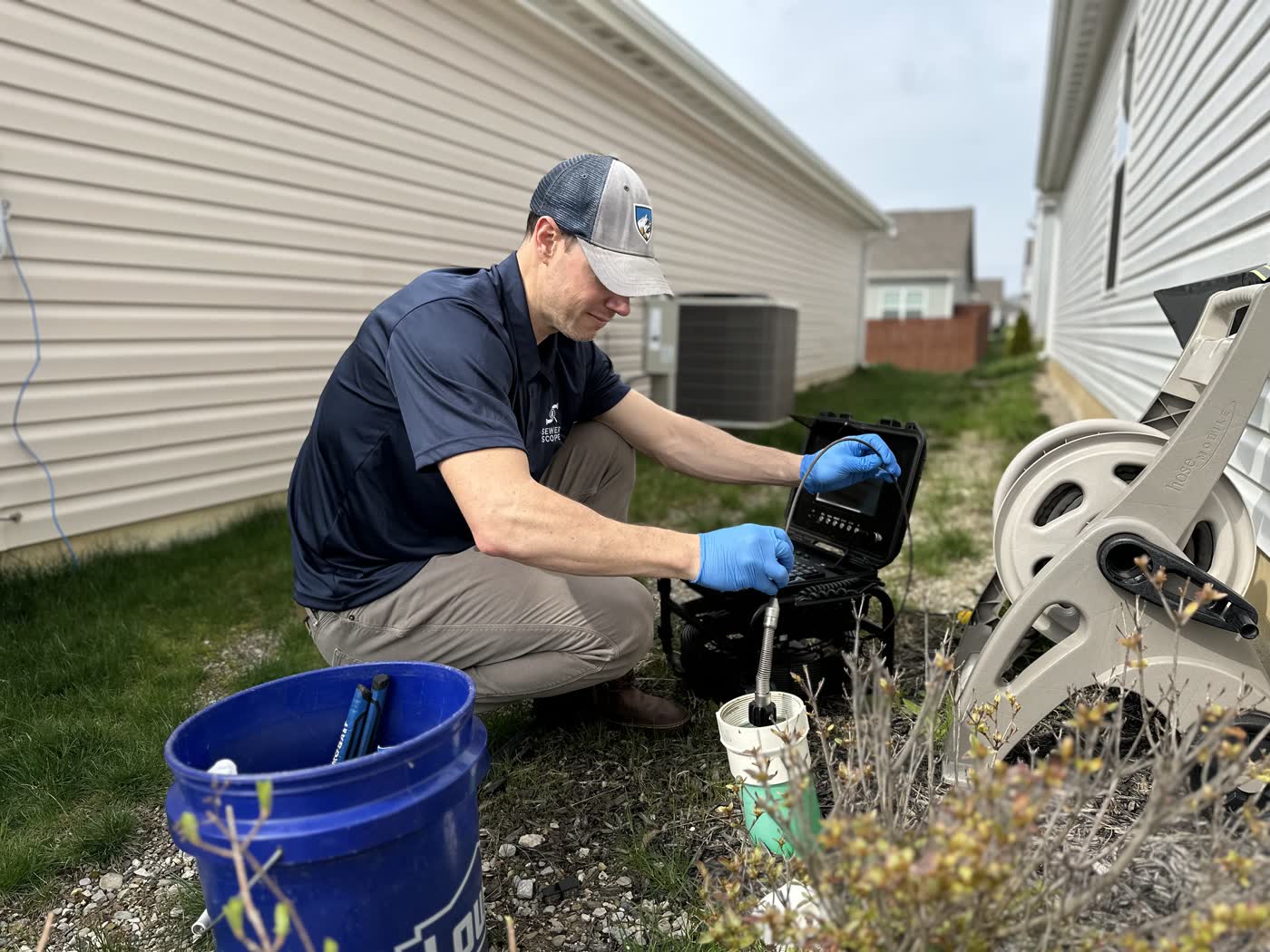
Arapahoe County inspections run on the same platform every Sewer Scope metro uses. Booking by phone at (720) 239-2322 or online. Same-week appointment standard, with Mon-Fri 7a-7p MT · Sat 8a-4p window. The technician arrives in the agreed window, locates the cleanout, runs the camera from access to the sanitation district city tap with footage marked, and packs out. The report follows in roughly 24 hours, distributed to buyer, agent, plumber, and lender as requested.
Arapahoe-specific notes: pre-1960 Englewood and original Aurora properties frequently have no exterior cleanout, requiring access through a basement toilet or a removed cleanout cap on the interior stack. Cherry Hills Village long-run laterals sometimes require the camera at full extension; we carry the equipment for it. Centennial and Greenwood Village newer-stock properties have standard exterior cleanouts and run quickly. Sewer Scope Denver operates as the metro-wide arm of the Sewer Scope network, coordinating with Front Range Sewer Scope as Sean's Denver co-brand.
Arapahoe County skews newer. The U.S. Census American Community Survey reports the median Arapahoe County housing unit was built in 1979, more than a decade newer than Denver County. The defect catalog therefore shifts: less cast iron and clay tile, more PVC bellies from bentonite-soil heaving, more Orangeburg in the older 1950s and early 1960s pockets, and fewer of the pre-1900 catastrophic finds that dominate Capitol Hill scopes. Englewood is the inner-ring exception with streetcar-era stock dating to 1910.
Source: U.S. Census Bureau Arapahoe County Colorado QuickFactsService is fragmented across multiple special districts and city utilities. Aurora Water serves the Arapahoe County portion of Aurora. South Suburban Sanitation District covers most of Centennial and Littleton. Englewood Utilities serves the City of Englewood. Cherry Hills Village uses several smaller districts including Cherry Hills Heights and Southwest Metropolitan. Greenwood Village contracts with Arapahoe County Water and Wastewater Authority. Verify your specific service district before any lateral work because permit jurisdiction varies block by block.
Source: Arapahoe County government · South SuburbanYes. One-acre minimum zoning means lateral runs of 150 to 250 feet are common. Long runs amplify the bentonite-heaving problem because more linear feet of pipe is exposed to differential soil movement. Cherry Hills scopes commonly show three or four step-offsets at clay-tile joints along a single run. The older estate homes (1940s-1960s) carry cast iron and Orangeburg risk; the post-1990 luxury rebuilds are PVC. Both still benefit from a scope because of the long-run heaving exposure.
Source: City of Cherry Hills VillageEnglewood is one of the older inner-ring suburbs in the metro, incorporated 1903 and built out heavily 1910 through 1960. The Old Englewood Historic District holds streetcar-era bungalows and four-squares from the 1910s and 1920s with original cast iron and vitrified clay tile laterals. Mid-century Englewood (1945-1965) is the textbook Orangeburg window. Englewood Utilities serves the city directly. Pre-listing scope is essentially mandatory on Old Englewood listings.
Source: Englewood UtilitiesCentennial was incorporated in 2001 but the underlying housing stock dates from 1965 through 1995. Lateral material is mostly PVC, with significant cast iron in the 1965-1975 builds along Arapahoe Road and Quincy Avenue. The dominant defect mode is PVC bellies from bentonite-driven soil heaving rather than material failure. Pierre Shale geology runs continuous from Denver County into Centennial; the expansive-soil problem does not stop at the county line.
Source: City of CentennialYes. Colorado Revised Statutes 38-35.7-102 and the Colorado Real Estate Commission's mandatory Seller's Property Disclosure (Residential) form (SPD19) require the seller to disclose the source of water and sewer service, any known defects, and any history of backups or repairs. DMAR treats pre-listing scope as best practice on any pre-1985 Arapahoe County listing.
Source: Denver Metro Association of REALTORSArapahoe County is the second-highest-volume residential market in the Front Range for Denver Metro Association of REALTORS (DMAR) members listing through REcolorado MLS (per DMAR and REcolorado). The scope conversation here splits by submarket: in Englewood and original Aurora it is essentially mandatory due diligence on any pre-1980 listing; in Centennial and Greenwood Village it is best-practice for any 1965-1985 build because of the PVC belly pattern. Colorado Revised Statutes 38-35.7-102 and the SPD19 disclosure form already require sewer-system answers, and a documented pre-sale scope answers them cleanly. Same professional report and high quality video. Same 24-hour turnaround. Clean handoff with no repair upsell.
Capitol Hill, Park Hill, Berkeley, Wash Park, Stapleton. Full century build spread.
Lakewood, Wheat Ridge, Golden, Arvada. Foothills geology and decomposed granite.
Arapahoe + Adams. Anschutz, Buckley SFB, original Aurora 1920s clay, Tower 1990s+ PVC.
Castle Rock, Highlands Ranch, Parker, Lone Tree. Mostly 1980-2010 master-planned PVC.
Westminster, Thornton, Northglenn, Commerce City. Industrial legacy in Commerce City.
Boulder, Longmont, Louisville, Lafayette. CU late-1880s housing near campus.