
Jefferson County is the foothills county west of Denver, running from Lakewood's eastern boundary at Sheridan Boulevard up the mountain front into Evergreen, Conifer, and the Pike-San Isabel National Forest line. Elevation runs 5,300 to 8,500 feet across the developed footprint. The geology shifts from Pierre Shale on the plains into decomposed granite at the mountain front. The build pattern follows: dense 1950s-1980s suburban in Lakewood, Wheat Ridge, and Arvada on Pierre Shale, plus 1960s-2000s mountain residential in Evergreen and Conifer on decomposed granite. Many mountain parcels are on private septic, not public sewer. The defect catalog therefore mixes Front Range bentonite-heaving with mountain-community private septic and 150-foot lateral runs. About 25 minutes on camera figures out which catalog applies.
Jefferson County covers 774 square miles, ranging from urban Lakewood on the eastern flatland up into the Front Range itself. The 2020 census recorded 580,451 residents (per U.S. Census Bureau QuickFacts). The American Community Survey reports the median Jefferson County housing unit was built in 1976. The defect catalog reflects a build period concentrated 1950 through 1990, with the mountain communities adding a 1970s-2000s second wave and the historic Golden core providing a pre-1900 pocket. Lateral material profile: cast iron in pre-1975 builds, Orangeburg in the 1955-1968 window, PVC after roughly 1975, and a substantial share of mountain properties on private septic entirely.
Lakewood is the largest city in Jefferson County and incorporated in 1969 as a defensive measure against Denver annexation. The housing stock dates from 1950 through 1985 across most of the city, with newer infill in Belmar (the mixed-use redevelopment of the former Villa Italia mall, opened 2004) and along the West Colfax light-rail corridor. Cast iron dominates the 1950-1970 builds, with significant Orangeburg in the 1955-1968 pockets. The Daniels Park views section and Bear Creek follow the same age curve. Pierre Shale geology underlies most of Lakewood with heavy bentonite content, the same expansive-soil problem documented for Denver County.
Wheat Ridge is the smaller inner-ring suburb directly north of Lakewood, incorporated 1969. Older than Lakewood overall, with significant 1940s-1950s housing stock and some pre-1940 farmstead conversions. Wheat Ridge Sanitation District serves the city. The defect catalog here trends toward the older end of the spectrum: cast iron everywhere, Orangeburg in mid-century pockets, and the occasional vitrified clay tile in pre-1940 originals.
Golden is the historic Jefferson County seat, founded 1859 and serving as the original Colorado Territory capital. The downtown historic district holds late-1800s and early-1900s commercial and residential buildings on original cast iron and vitrified clay tile laterals. The newer Golden subdivisions (post-1970, including the Genesee Foundation and the Lookout Mountain communities) follow the standard Front Range PVC pattern. The mining-era foundations under some downtown buildings add a wrinkle: original utility runs sometimes pass through old shaft backfill, which settles differentially over decades and pulls laterals out of alignment.
Arvada straddles the Jefferson-Adams County line but is centered in Jefferson. The housing stock dates from 1955 through 1995 with significant Olde Town Arvada historic core dating to the 1870s railroad era. Consolidated Mutual Water and the Arvada Water Department share service of most parcels. The defect catalog tracks the build-year pattern: Olde Town carries clay tile and cast iron; the post-1955 buildout is mostly cast iron transitioning to PVC by 1975.
Evergreen and Conifer are the mountain residential communities. Elevations run 7,000 to 8,500 feet. Most parcels here are on private septic rather than public sewer because mountain density does not support a centralized collection grid. The Evergreen Metropolitan District serves a few central Evergreen blocks with public sewer. A scope on a septic property terminates at the tank inlet rather than a city tap, and the camera documents inlet condition as part of the report. Mountain laterals to septic tanks commonly run 150 to 300 feet across larger parcels, which amplifies freeze-thaw fatigue.
Morrison and Edgewater round out the smaller incorporated communities. Morrison is a small mountain-front community famous for the Red Rocks Amphitheatre area, with mostly 1960s-1990s housing on PVC. Edgewater is a 0.7 square mile enclave on the eastern boundary of Jefferson County immediately west of Sloan's Lake in Denver, with dense 1920s-1950s housing on cast iron and Orangeburg.
Soil across Jefferson County varies more than any other metro county. The eastern flatland (Lakewood, Wheat Ridge, Arvada, Edgewater) sits on Pierre Shale with bentonite content matching Denver County. The mountain-front parcels (Genesee, Lookout Mountain, Morrison) sit on decomposed granite of the Pikes Peak Granite and Idaho Springs Formation. The Evergreen and Conifer parcels sit on a mix of granite and Precambrian metamorphic rock (per Colorado Geological Survey). Decomposed granite is non-expansive but extremely abrasive on cast iron laterals over decades, and the granular soil drains poorly during winter freeze-thaw cycles, driving lateral frost-jacking in mountain installs.
1. Bentonite-driven differential heaving (Lakewood, Wheat Ridge, Arvada, Edgewater). The eastern flatland of Jefferson County sits on the same Pierre Shale and Denver Formation bentonite that defines Denver County's defect catalog. Bentonite swell potential of 100 percent or more between dry and saturated state (per Colorado Geological Survey) drives differential heaving that fractures rigid materials. On camera in pre-1975 Lakewood and Wheat Ridge cast iron: shear-cracked sections with visible displacement. On camera in post-1975 PVC: belly formation where the camera tilts down through a low spot.
2. Cast iron scale on any pre-1980 Jefferson County build. Cast iron was the Jefferson County standard from the 1900s through the late 1970s. Documented service life is 50 to 75 years (per Cast Iron Soil Pipe Institute), putting nearly every original install at end-of-life. Heavy black scale on the pipe floor narrows the effective diameter substantially. Lakewood-area descaling runs $200 to $800 depending on length and access. The Wheat Ridge defect rate runs higher than Lakewood because the housing stock skews 10 to 15 years older on average.
3. Orangeburg in the 1948 to 1968 window (Wheat Ridge, original Lakewood, original Arvada). Orangeburg (bituminous fiber conduit) was widely used across Jefferson County during the post-war building boom. Documented mean failure age is 30 to 50 years (per U.S. EPA pipe materials reference), so every Orangeburg lateral in Jefferson County is past expected service life. On camera: deformed oval cross-section, blistered interior wall, partial collapse. Repair is full replacement. Jefferson-area Orangeburg replacement runs $4,000 to $15,000 plus the sanitation district permit.
4. Mountain-community frost-jacking on decomposed granite (Evergreen, Conifer, Genesee, Lookout Mountain). Decomposed granite is non-expansive but the granular structure drains poorly during the freeze-thaw cycle. Water in the granular matrix freezes and expands, pushing the lateral upward in cyclic frost-jacking. Mountain laterals at 7,500-foot elevation see 110-plus freeze-thaw cycles per year (per Colorado Climate Center) compared to roughly 90 at Denver's 5,280-foot baseline. Cumulative frost-jacking over 30 to 40 years produces visible lateral displacement and joint separation. Mountain lateral repair runs $1,500 to $4,000 because access depth and seasonal trenching windows are both unfavorable.
5. Private septic inlet failure (Evergreen, Conifer, Genesee mountain parcels). Most Evergreen and Conifer parcels are on private septic. The Jefferson County Public Health Department oversees on-site wastewater treatment system (OWTS) permitting. A scope on a septic property terminates at the tank inlet, where the camera documents inlet baffle condition, tank lid seal, and the lateral run from house to tank. Septic inlet failures are common on systems past 25-year service life. Tank replacement plus drainfield rehab runs $4,000 to $15,000 depending on terrain and access. Pre-purchase septic inspection plus camera scope is standard due diligence on any mountain-community resale.
6. Historic Golden mining-era backfill settling. Original Golden downtown buildings (pre-1900 commercial and residential along Washington Avenue, Ford Street, and the Clear Creek corridor) sometimes have original lateral runs passing through old mining shaft backfill. The backfill continues to settle differentially over decades and pulls laterals out of alignment. On camera: visible step-offset at one or more joints, often combined with belly formation in the same run. Repair requires careful trenching to avoid disturbing adjacent historic foundations. Golden mining-era repairs commonly run $1,500 to $5,000.
One additional Jefferson County variable: the jurisdictional fragmentation is the most extreme in the metro. Consolidated Mutual Water, Northwest Lakewood Sanitation District, Wheat Ridge Sanitation, City of Golden Public Works, Arvada Water Department, Evergreen Metropolitan District, and Jefferson County Public Health (for OWTS septic) all have different permit windows, connection fees, and inspection requirements. Verify your specific district before booking any repair work because the permit landscape varies meaningfully block by block.
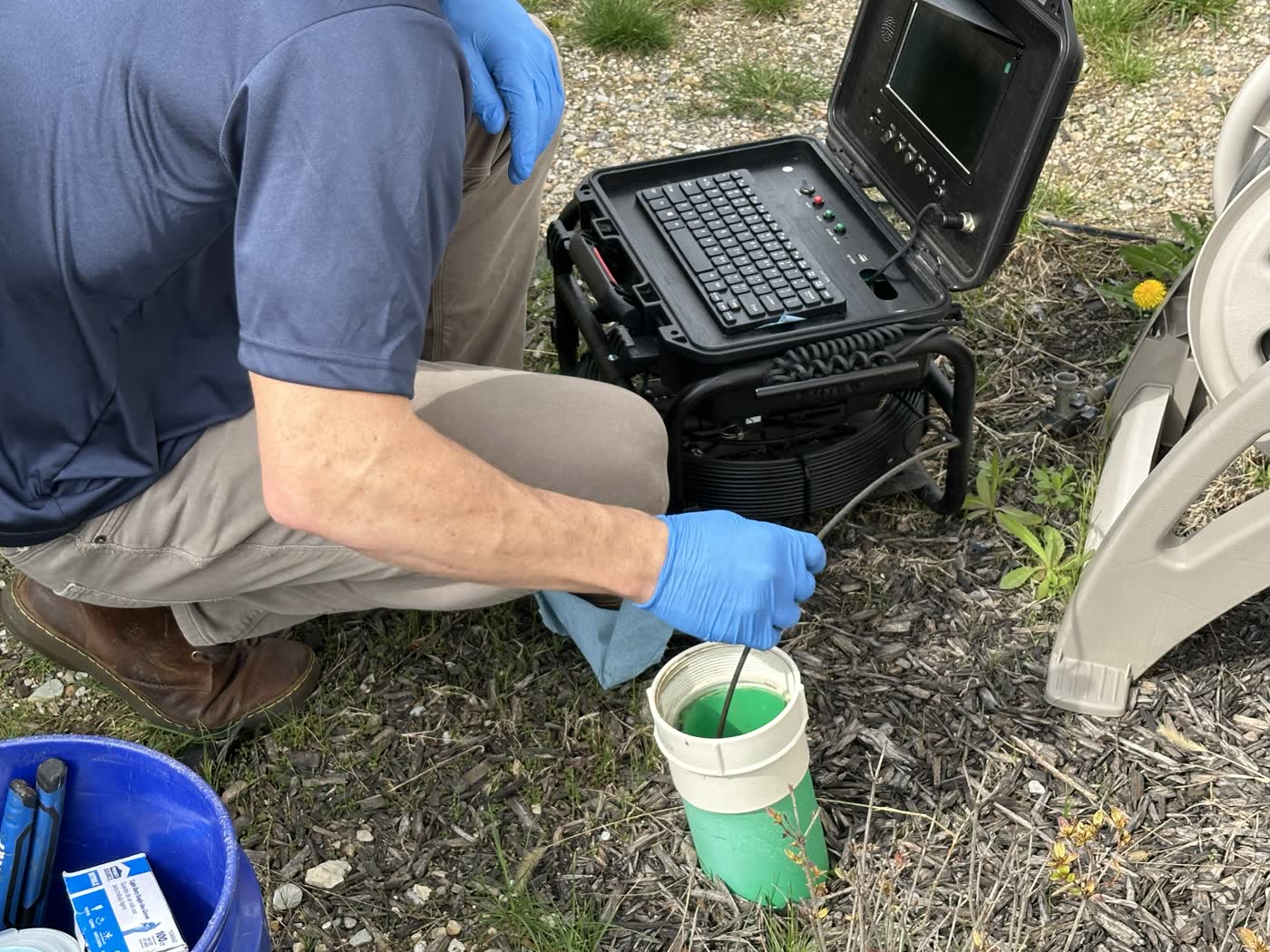
Jefferson County inspections run on the same platform every Sewer Scope metro uses. Booking by phone at (720) 239-2322 or online. Same-week appointment standard, with Mon-Fri 7a-7p MT · Sat 8a-4p window. The technician arrives in the agreed window, locates the cleanout (or the septic access port for mountain properties), runs the camera from access to the city tap or septic inlet with footage marked, and packs out. The report follows in roughly 24 hours, distributed to buyer, agent, plumber, and lender as requested.
Jefferson-specific notes: pre-1960 Wheat Ridge and Olde Town Arvada properties frequently have no exterior cleanout, requiring access through a basement toilet or a removed cleanout cap on the interior stack. Evergreen and Conifer mountain properties on private septic require a septic-tank pump-out coordinated with the local OWTS service provider in addition to the camera run; we coordinate that handoff. Belmar and post-2000 Lakewood infill have standard exterior cleanouts and run quickly.
Jefferson County is the foothills county. The geology shifts from the bentonite-rich Pierre Shale of the eastern plains into decomposed granite at the mountain front. Elevation runs 5,300 feet in Lakewood up to 8,500 feet in Conifer. The build pattern reflects that geography: dense 1950s-1980s suburban in Lakewood and Arvada on Pierre Shale, plus 1960s-2000s mountain residential in Evergreen and Conifer on decomposed granite. Many mountain parcels are on private septic, not public sewer.
Source: U.S. Census Bureau Jefferson County Colorado QuickFactsService is one of the most fragmented in the metro. Consolidated Mutual Water serves Lakewood and parts of Wheat Ridge. Northwest Lakewood Sanitation District covers other Lakewood sections. Wheat Ridge Sanitation District serves Wheat Ridge proper. Golden uses City of Golden Public Works. Arvada is served by Consolidated Mutual and the Arvada Water Department. Evergreen Metropolitan District covers mountain communities. Conifer parcels are mostly on private septic. Verify your district before any lateral work.
Source: Jefferson County governmentYes. Most Evergreen and Conifer properties sit on private septic systems rather than public sewer. A scope on a septic property terminates at the tank inlet rather than a city tap, and the camera documents inlet condition. Property elevation in this submarket ranges 7,000 to 8,500 feet, which means freeze-thaw cycles are even more aggressive than at the 5,280-foot Denver baseline. Mountain laterals also commonly run 150 to 300 feet across larger parcels.
Source: Jefferson County Public Health OWTSLakewood incorporated in 1969 but housing stock dates 1950 through 1985. Cast iron dominates the 1950-1970 builds, with significant Orangeburg in the 1955-1968 mid-century pockets. PVC takes over after roughly 1975. Belmar (the mixed-use redevelopment of the former Villa Italia mall, opened 2004) is all-PVC. Original Lakewood pre-1969 is the high-defect-rate stock. Pierre Shale geology continues from Denver County into Lakewood, so the bentonite-driven heaving problem is identical.
Source: City of Lakewood ColoradoGolden is one of the oldest communities in Jefferson County, founded 1859 and the original Colorado Territory capital. The downtown historic district holds late-1800s and early-1900s buildings on original cast iron and clay tile. Mining-era foundations under some downtown buildings add a wrinkle: original utility runs sometimes pass through old shaft backfill, which settles differentially and pulls laterals out of alignment. The newer Golden subdivisions follow the standard Front Range PVC pattern.
Source: City of GoldenYes. Colorado Revised Statutes 38-35.7-102 and the SPD19 form require the seller to disclose the source of water and sewer service (public, well, septic), any known defects, and any history of backups or repairs. For Evergreen and Conifer septic properties, the SPD19 also requires disclosure of septic tank inspection and pumping history. DMAR treats pre-listing scope or septic inspection as best practice on any pre-1985 Jefferson County listing.
Source: Denver Metro Association of REALTORSJefferson County is the third-highest-volume residential market in the Front Range for Denver Metro Association of REALTORS (DMAR) members listing through REcolorado MLS (per DMAR and REcolorado). The scope conversation splits by submarket: in original Lakewood, Wheat Ridge, and Olde Town Arvada it is essentially mandatory due diligence on any pre-1980 listing; in mountain communities (Evergreen, Conifer, Genesee) septic inspection plus lateral scope is standard pre-purchase work. Colorado Revised Statutes 38-35.7-102 and the SPD19 disclosure form require sewer-system answers, and a documented pre-sale scope answers them cleanly. Same professional report and high quality video. Same 24-hour turnaround. Clean handoff with no repair upsell.
Belmar, Green Mountain, Federal Center, Bear Creek. 1950s-1980s build dominant on Pierre Shale.
Capitol Hill, Park Hill, Berkeley, Wash Park, Stapleton. Full century build spread.
Westminster, Thornton, Northglenn, Commerce City. Industrial legacy in Commerce City.
Boulder, Longmont, Louisville, Lafayette. CU late-1880s housing near campus.
Aurora west, Centennial, Englewood, Cherry Hills. Mostly 1960s-1990s suburban.
Castle Rock, Highlands Ranch, Parker, Lone Tree, Castle Pines. Mostly 1980-2010 PVC.