
A sewer scope inspection sends a small, high-resolution waterproof camera through the home's sewer lateral, from the cleanout to the Denver wastewater tap. The technician records video and stills of any defect along the entire run. The output is a PDF report plus a shareable video link. In Denver, the camera is looking for two things you do not see in flatter, lower-elevation metros: bentonite-soil heaving and altitude freeze-thaw cracking. Plus the universal set: roots, scale, cracks, offsets, and bellies. About 25 minutes on site. Report inside 24 hours. $299 starting.
The Sewer Scope Inspection process in Denver is identical to what NACHI describes nationally (InterNACHI): a waterproof camera on a flexible push rod is inserted through a cleanout or pulled toilet, advanced through the lateral pipe to the connection at the city main, and recorded video is reviewed for visible defects. Spectora (a major inspector-software platform) treats sewer scope as an essential ancillary inspection for any pre-1980 home (Spectora). Rocket Mortgage publishes buyer-side guidance recommending scope on pre-1980 stock regardless of loan type (Rocket Mortgage).
The Denver context layers two physical realities on top of the national norm. First, Denver sits at 5,280 feet with more than 90 freeze-thaw cycles per year on the NOAA Denver climate normals. Indianapolis records roughly 70 cycles. Each cycle widens any hairline crack in cast iron or clay tile by a measurable fraction. Capitol Hill cast iron from the 1890s has now absorbed roughly 13,000 freeze-thaw cycles. Second, Front Range soils are bentonite-rich expansive clays. The Colorado Geological Survey maps the hazard moderate to high across most of the Denver metro (Colorado Geological Survey). The clay swells when wet and contracts when dry. Sewer laterals buried in it get pushed up, dragged down, and twisted across the seasons.
Both factors mean the Denver defect rate skews toward offset joints, bellies, and joint separations rather than the cast-iron scaling pattern that dominates Indianapolis findings. A Capitol Hill 1903 lateral is rarely a clean run. The scope tells you exactly where the offsets sit.
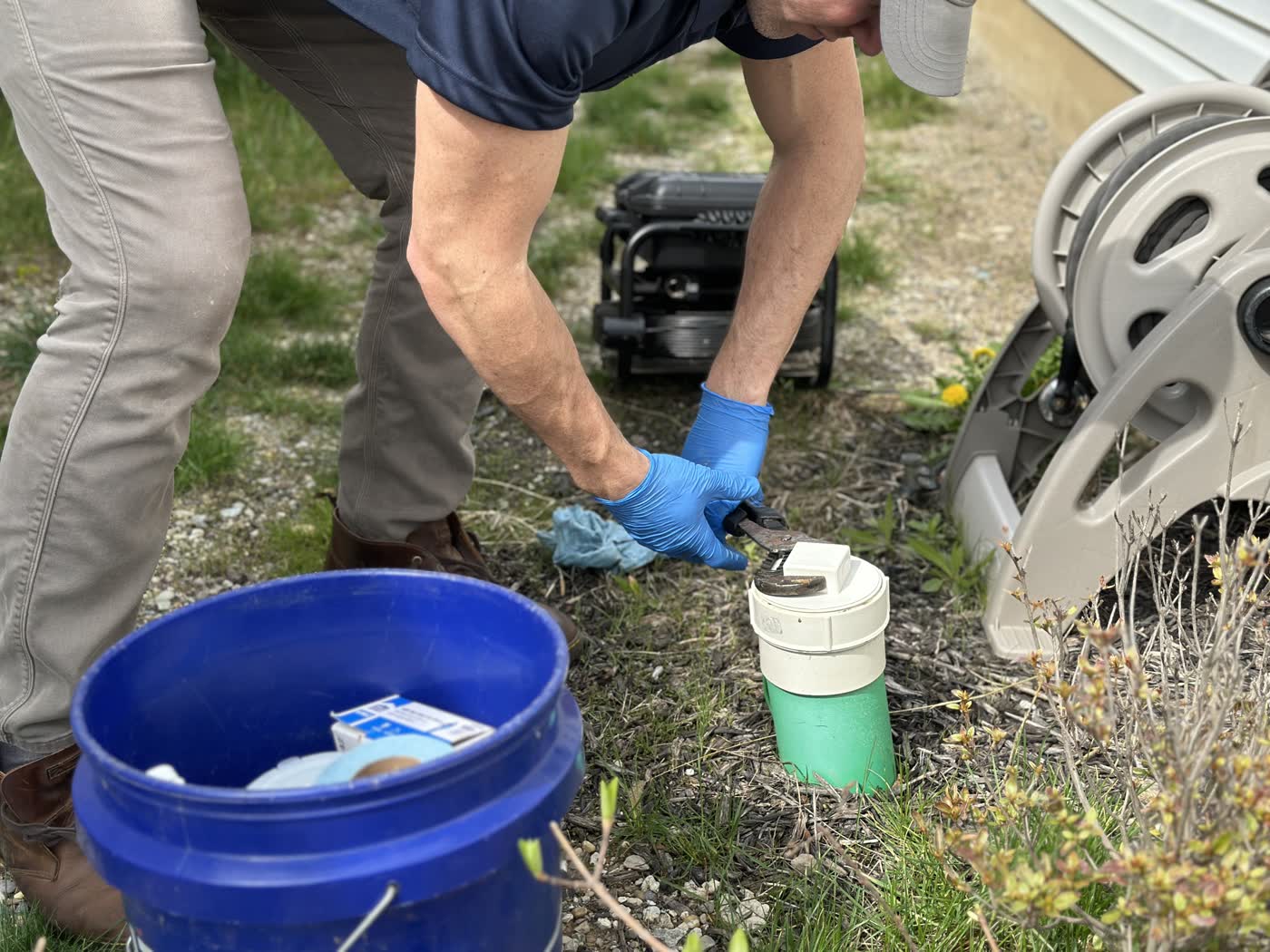
The camera head is roughly the diameter of a US quarter. It mounts on a flexible fiberglass push rod that lets the operator advance it through 4-inch (and sometimes 6-inch) residential lateral pipe. The rod is marked at one-foot intervals so depth and footage of every finding is documented. A sonde transmitter in the camera head lets the operator locate the camera through the soil from the surface using a separate receiver wand, so the exact ground location of any defect is mapped before any repair excavation begins.
Higher-end systems record HD video continuously and capture annotated still frames. The report format used across the Sewer Scope network includes the full video plus video capture of any finding plus a one-page summary of severity. Denver scope deliverables match Indianapolis and Cincinnati, just with the Front Range defect set (bentonite-soil heaving, altitude freeze-thaw cracking) flagged distinctly. ASHI (American Society of Home Inspectors) publishes similar deliverable guidance (ASHI).
The seven defects the camera identifies are universal: roots, scale, cracks, offsets, bellies, joint separations, and tap connection problems. The Denver weighting on those seven is unique. Bentonite-soil heaving and altitude freeze-thaw cracking dominate the findings on pre-1980 housing stock.
Expansive-soil heaving. The Colorado Geological Survey maps the hazard moderate to high across most of central Denver. Bentonite and montmorillonite clays expand when wet and contract when dry. Laterals move differentially across the seasons, opening offsets at joints and creating bellies at low spots. Capitol Hill (80218), Cheesman Park, Park Hill (80205, 80207), Berkeley (80211), Sloan's Lake (80212), and Wash Park (80209) are textbook expansive-soil zones with century-old clay tile laterals (Colorado Geological Survey, Colorado Department of Transportation: expansive-soil guidance).
Altitude freeze-thaw cracking. NOAA Denver climate normals record more than 90 freeze-thaw cycles per year. Each cycle widens hairline cracks in cast iron and clay tile. A pre-1920 Capitol Hill cast iron lateral has absorbed roughly 13,000 cycles. Most fail in the joints first, then propagate to longitudinal cracks. Spot the cracking pattern on camera and the timing of the next failure becomes predictable.
Cast iron scale and historic clay tile. Cast iron lifespan is 50 to 100 years, with deterioration commonly beginning after 25 (Balkan Plumbing). Capitol Hill brownstones from the 1890s and 1900s, Park Hill bungalows from the 1900s through 1930s, and the older Berkeley and Highlands lots all skew heavily toward cast iron or hand-laid clay tile. By the time these laterals reach the resale market today, they are well into the failure window. Descaling can restore cast iron diameter and extend life. Clay tile separations typically need full replacement.
Root intrusion. The Denver root-intrusion tree species are different from Indianapolis. Cottonwood (Populus deltoides) is the Front Range sewer-line wrecker. Russian olive (Elaeagnus angustifolia) is the second offender, particularly in older Berkeley and Sloan's Lake yards. Siberian elm rounds out the top three (Colorado State Forest Service). Indianapolis silver maple and Cincinnati Norway maple barely appear in Denver soil. Roots cause more than half of all sewer blockages nationally (ARS).
Tap connection problems. The point where the homeowner's lateral meets the Denver wastewater main is often where Front Range soils have shifted the connection over a century. Denver DOTI handles the main; Metro Wastewater Reclamation District treats flow downstream (Metro Wastewater Reclamation District, Denver DOTI). The homeowner pays for any lateral repair, including at the tap.
Day one: book online or call (720) 239-2322. Same-week appointments are standard across Denver County, Arapahoe, Jefferson, Adams, and Douglas counties. We confirm housing-stock era and ZIP risk during the booking call so we arrive prepared. For pre-1920 Capitol Hill, Cheesman Park, and Park Hill homes that do not have an exterior cleanout, we plan the pulled-toilet pull in advance with the seller or listing agent.
Day of scope: 25 minutes on site for a typical Denver residential lateral. The camera enters at the cleanout. The operator advances through the lateral to the Denver wastewater tap, recording continuously, capturing video capture at any finding. Footage is marked as we go. The operator sondes any defect to the surface so a future plumber can excavate directly above it without guess-work.
Within 24 hours: PDF and shareable video link delivered to the buyer (or seller), the listing agent, the buyer agent, and the lender. For pre-purchase scopes in active transactions, the report is timed to land inside the Colorado Inspection Objection Deadline window so the buyer plumber has time to bid the fix if needed.
NACHI (InterNACHI) is explicit on the separation: the operator scoping the line should not also be the operator bidding the repair, since that creates an unavoidable upsell conflict (InterNACHI). Many Denver-area home inspectors do not run sewer cameras themselves; the equipment, training, and report format are different. ASHI (ASHI) treats sewer scope as a separate ancillary inspection.
Front Range Sewer Scope (Sewer Scope Denver) does not bid repairs and does not refer to a specific Denver plumber for repair work. The report is the report. The buyer plumber (or any Denver-area plumbing contractor the buyer chooses) bids the fix. That separation is structural to the way the network operates.
InterNACHI publishes the original technical guidance for sewer scope work and most Denver-area home inspectors who do offer the service are NACHI-certified. ASHI publishes overlapping standards. Both organizations recommend scope as a separately-ordered ancillary on any pre-1980 residential transaction.
The Denver metro covers roughly 3 million people across Denver, Arapahoe, Jefferson, Adams, and Douglas counties (Colorado State Demography Office). A meaningful share of that housing stock is pre-1980. Central Denver bungalow neighborhoods (Capitol Hill, Park Hill, Berkeley, Wash Park, Cheesman Park, Congress Park, Highlands, Sloan's Lake) date primarily from the 1890s through the 1940s. The 1945 to 1972 postwar wave filled in Hampden, Wellshire, Indian Creek, parts of Park Hill North, and Lowry edges. Post-2000 redevelopment (Central Park / former Stapleton, Lowry, Highlands Ranch, Lone Tree, Castle Rock) is where PVC dominates.
That distribution, combined with the Front Range expansive-soil overlay, means the Denver scope-justification rate is among the highest in the Sewer Scope network. Cabin City (former Stapleton 80238) and Highlands Ranch are the exception cases. Everywhere else in the central metro, a buyer asking "should I scope?" is almost always asking the wrong question. The right question is when, and inside what Inspection Objection Deadline window.
Sewer Scope Denver operates locally as Front Range Sewer Scope. Same equipment, same platform, same report format, same no-upsell standard as Sewer Scope Indianapolis (headquarters) and Sewer Scope Cincinnati. The Front Range branding mention reflects that the Denver operator works inside the larger network rather than as a standalone independent. The booking flow, the scheduling, the report turnaround, and the pay-after-inspection billing design are all network-standard.
If you are coming to this page from a Denver-area realtor, lender, or title company referral, the same URL works regardless of network branding. The phone routes through the Sewer Scope Indianapolis corporate line at (720) 239-2322 until the Denver office stands up a local Denver number. Email [email protected] for partnership-level conversations.
Same-week appointments across the five-county Denver metro. (720) 239-2322.