
Adams County is the northern suburban arc of the Denver metro and one of the fastest-growing counties in Colorado. The build pattern here is 1960s through 1990s suburban dominant across Westminster, Thornton, Northglenn, and the Adams portion of Aurora, plus two distinct outliers: Commerce City carries heavy industrial-grade legacy plumbing from its 1950s-1980s refinery and trucking corridor history, and Brighton retains pre-1940 farm-town housing along the historic county-seat downtown along the South Platte River. Pierre Shale bentonite-heaving continues from Denver County into Adams County. Galvanized steel laterals appear in Commerce City scopes more often than in any other Front Range county. About 25 minutes on camera tells you which pattern applies to a specific address.
Adams County covers 1,182 square miles north and northeast of Denver, ranging from inner-ring suburban Westminster up through the agricultural plains of eastern Adams toward the Weld County line. The 2020 census recorded 519,572 residents (per U.S. Census Bureau QuickFacts). The American Community Survey reports the median Adams County housing unit was built in 1981, the newest median in the Front Range counties. The defect catalog reflects that age skew: more PVC, less cast iron and clay tile, plus the two specific outliers that make Adams County operationally distinct from the other Front Range counties.
Westminster was incorporated in 1911 as a small farm community but the bulk of the residential housing dates from 1955 through 1985. The Federal Heights enclave inside Westminster's boundaries holds dense 1960s-1970s multifamily and single-family on cast iron and Orangeburg. The Westminster Boulevard and 144th Avenue corridors saw significant late-1990s and 2000s expansion on PVC. North Washington Water and Sanitation District serves most Westminster parcels. The Westminster Promenade and the Adams County Government Center sit on Pierre Shale with heavy bentonite content.
Thornton was platted in 1953 by developer Sam Hoffman and grew rapidly through the 1960s and 1970s as a planned suburban community modeled on Levittown patterns. The original Thornton housing stock (1955-1975) is uniformly small ranch homes on cast iron laterals. Newer Thornton expansions north of 120th Avenue and along the Highway 7 corridor are PVC. The City of Thornton operates its own water and wastewater utility independently. The defect pattern is dominated by 50-year-old cast iron at end of documented service life.
Northglenn is the small inner-ring suburb between Thornton and Westminster, incorporated 1969. The housing stock dates almost entirely from 1959 through 1975, with the original Northglenn subdivisions developed by the Perl-Mack Construction Company. Cast iron laterals dominate. North Washington Water and Sanitation District covers most Northglenn parcels.
Commerce City is the operational outlier in Adams County. Originally platted in the 1950s as an industrial sister-city to Denver, Commerce City still holds the Suncor Energy refinery (the only oil refinery in the Front Range), the Vasquez Boulevard heavy-manufacturing corridor, and significant trucking and warehouse footprint. The residential housing built during the 1950s-1980s industrial peak frequently used industrial-grade galvanized steel laterals rather than standard residential cast iron, plus heavier wall-thickness Orangeburg in some 1960s pockets. South Adams County Water and Sanitation District serves Commerce City. The defect catalog here is unique: galvanized steel tuberculation, industrial-corridor soil contamination concerns at any repair excavation, and the older Stapleton-airport-edge clay tile in some northern-Commerce-City pockets.
Brighton is the Adams County seat along the South Platte River corridor. Originally a farm-town serving the surrounding agricultural belt, Brighton retains pre-1940 commercial and residential housing along the historic downtown along Main Street, Bridge Street, and Bromley Lane. The lateral material in the historic core is vitrified clay tile and first-generation cast iron. Suburban Brighton expansion (Brighton Crossing, Prairie Center, the post-1985 build along Highway 85) is uniformly PVC. The City of Brighton operates its own municipal utility.
Adams portion of Aurora covers the northern third of the City of Aurora, including the East Colfax corridor north of I-70. The housing stock here is mostly 1960s-1980s suburban with newer infill near Anschutz Medical Campus. Aurora Water serves the Adams portion of Aurora identically to the Arapahoe portion (single citywide utility regardless of which county the parcel sits in).
Soil across Adams County continues the Pierre Shale and Denver Formation pattern of the Front Range, with bentonite-rich pockets concentrated in Westminster, Northglenn, and the eastern Aurora-north area (per Colorado Geological Survey). Commerce City sits over the same Pierre Shale plus historic floodplain alluvium along the South Platte and Sand Creek corridors. Brighton sits over South Platte River alluvial soils that are less expansive than the upland Pierre Shale but still subject to differential settlement on the older farm-town parcels.
1. Bentonite-driven differential heaving (universal across the suburban arc). Westminster, Thornton, Northglenn, and Aurora north all sit on Pierre Shale with bentonite content matching Denver County's expansive-soil problem. Swell potential of 100 percent or more between dry and saturated state (per Colorado Geological Survey) drives differential heaving that bellies PVC and fractures cast iron. On camera in 1960s-1975 cast iron: shear-cracked sections with visible displacement. On camera in post-1975 PVC: belly formation where the camera tilts down through a low spot.
2. Cast iron scale on pre-1980 Westminster, Thornton, Northglenn builds. Cast iron dominates the 1955-1975 Adams County suburban arc. Documented service life is 50 to 75 years (per Cast Iron Soil Pipe Institute), putting nearly every original install at or past end-of-life. Heavy black scale on the pipe floor narrows the effective diameter from 4-inch nominal to 2 inches or less. Adams-area descaling runs $200 to $800 depending on length.
3. Commerce City galvanized steel tuberculation (the operationally distinct Adams County finding). Galvanized steel laterals were installed across Commerce City residential during the 1950s-1980s industrial-corridor build period as a cost-saving substitute for cast iron. Galvanized steel corrodes from the inside out and develops heavy tuberculation (calcium and rust nodules adhered to the pipe wall) that severely narrows the effective diameter, often to less than 1 inch on a 4-inch nominal pipe. On camera: bumpy nodular interior wall with no clear flow path. Tuberculation cannot be reliably cleared by descaling because the nodule attachment is from corrosion bonding, not soft scale buildup. Repair is replacement. Commerce City galvanized lateral replacement runs $4,000 to $15,000 because excavation through historic industrial-area fill commonly requires additional environmental handling.
4. Orangeburg in mid-century Westminster, Northglenn, original Aurora-north (1948 to 1968 window). Orangeburg (bituminous fiber conduit) was widely used across Adams County during the post-war building boom. Documented mean failure age is 30 to 50 years (per U.S. EPA pipe materials reference), so every Orangeburg lateral is past expected service life. On camera: deformed oval cross-section, blistered interior wall, partial collapse. Repair is full replacement, with Adams-area Orangeburg replacement running $4,000 to $15,000 plus the sanitation district permit.
5. Historic Brighton clay tile in the pre-1940 downtown core. Vitrified clay tile laterals in short mortared sections dominate the Brighton historic downtown. Mortar joint failure plus root intrusion is the textbook finding. The aggressive Adams County root species are Siberian elm (heavy along the South Platte corridor), cottonwood across all floodplain parcels, Russian olive throughout the eastern county agricultural fringe, and honeylocust street plantings in Brighton downtown. American Society of Civil Engineers identifies root intrusion as a leading cause of sanitary sewer overflow nationally (per ASCE Infrastructure Report Card).
6. South Platte alluvial belly formation (Commerce City, Brighton, Adams-north Aurora floodplain parcels). Properties in the South Platte and Sand Creek floodplains sit on alluvial soils that compact unevenly over decades. Even PVC laterals develop belly formation in this geology. On camera: the camera tilts down then back up through a low spot with standing water in the dip. Belly repair runs $1,500 to $4,500 for a single section, with multiple-belly runs pushing toward $10,000 because access trenching gets longer.
One additional Adams County variable: jurisdictional permitting routes through five separate authorities depending on the parcel. South Adams County Water and Sanitation, North Washington Water and Sanitation, City of Thornton Utilities, City of Brighton Utilities, and Aurora Water all have different permit windows, connection fees, and inspection requirements. Verify your specific district before any lateral repair work. The Adams County Health Department oversees on-site wastewater treatment system (OWTS) permitting for the small share of unincorporated eastern-Adams parcels that remain on septic.
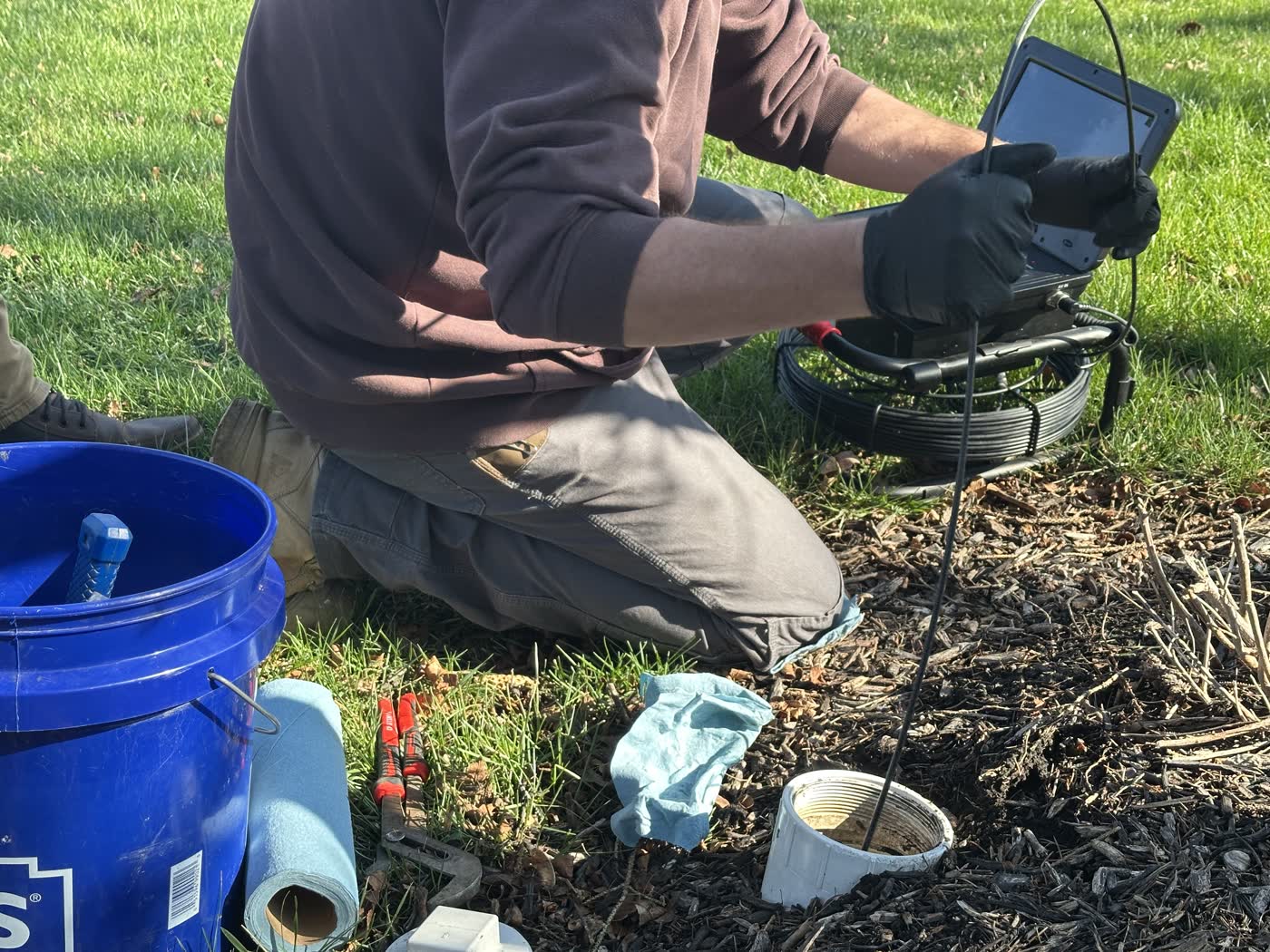
Adams County inspections run on the same platform every Sewer Scope metro uses. Booking by phone at (720) 239-2322 or online. Same-week appointment standard, with Mon-Fri 7a-7p MT · Sat 8a-4p window. The technician arrives in the agreed window, locates the cleanout, runs the camera from access to the city tap with footage marked, and packs out. The report follows in roughly 24 hours, distributed to buyer, agent, plumber, and lender as requested.
Adams-specific notes: Commerce City galvanized steel laterals require a camera and head capable of pushing through heavy tuberculation; we carry the equipment for it and document tuberculation severity on the report. Brighton historic downtown properties frequently have no exterior cleanout, requiring access through a basement toilet or a removed cleanout cap on the interior stack. Westminster, Thornton, and Northglenn newer-stock have standard exterior cleanouts.
Adams County is dominated by 1960s through 1990s suburban housing in Westminster, Thornton, Northglenn, and the Aurora north portion. Lateral material is mostly cast iron in the 1960-1975 builds transitioning to PVC after 1975. Two pockets break the pattern: Commerce City carries heavy industrial-grade legacy plumbing from its 1950s-1980s refinery and industrial corridor history, and Brighton retains pre-1940 farm-town housing along the historic downtown. The bentonite-rich Pierre Shale geology continues from Denver County.
Source: U.S. Census Bureau Adams County Colorado QuickFactsSouth Adams County Water and Sanitation District serves Commerce City. North Washington Water and Sanitation District covers Westminster, Federal Heights, parts of Northglenn. The City of Thornton operates its own water and wastewater utility. Brighton has its own municipal utility. The Adams County portion of Aurora is served by Aurora Water. Verify your specific district before any lateral work.
Source: Adams County governmentYes. Commerce City was platted in the 1950s as an industrial sister-city with significant oil refinery (Suncor Energy), trucking, and heavy-manufacturing presence. Residential housing built during the 1950s-1980s industrial peak frequently used industrial-grade galvanized steel laterals rather than standard residential cast iron, plus heavier wall-thickness Orangeburg in some 1960s pockets. Galvanized steel corrodes from the inside out and develops heavy tuberculation. Many Commerce City scopes document residual industrial-area soil concerns that add cost to any excavation repair.
Source: City of Commerce CityBrighton is the Adams County seat and was originally a farm-town along the South Platte River. The historic downtown holds 1900-1940 commercial and residential buildings on original vitrified clay tile and first-generation cast iron laterals. The post-1985 Brighton Crossing and Prairie Center subdivisions are PVC. Defect catalog splits sharply by parcel age: pre-1940 downtown is high-defect-rate clay tile and cast iron; post-1985 subdivisions are lower-defect-rate PVC, though even newer homes fail a sewer scope about 40% of the time, so a scope is still worth it.
Source: City of BrightonWestminster was incorporated 1911 but the bulk of housing dates 1955 through 1985, with significant late-1990s and 2000s expansion in the Westminster Boulevard and 144th Avenue corridors. Thornton was platted in 1953 by developer Sam Hoffman and grew rapidly through the 1960s and 1970s. Both follow the standard Front Range pattern: cast iron 1955-1975, PVC after 1975. North Washington Water and Sanitation covers Westminster; Thornton operates its own utility. Pierre Shale bentonite-heaving applies to both.
Source: City of Westminster · City of ThorntonYes. Colorado Revised Statutes 38-35.7-102 and the SPD19 disclosure form require the seller to disclose the source of water and sewer service, any known defects, and any history of backups or repairs. For Commerce City and Brighton properties, SPD19 also captures any industrial-area soil concerns. DMAR treats pre-listing scope as best practice on any pre-1985 Adams County listing, especially in Commerce City because of the galvanized steel lateral prevalence.
Source: Denver Metro Association of REALTORSAdams County is one of the fastest-growing residential markets in the Front Range for Denver Metro Association of REALTORS (DMAR) members listing through REcolorado MLS (per DMAR and REcolorado). The scope conversation splits by submarket: Commerce City listings are best-practice scope candidates because of the galvanized steel lateral prevalence; Westminster, Thornton, and Northglenn pre-1980 listings are essentially mandatory due diligence on age alone; Brighton historic downtown listings are mandatory on the pre-1940 clay tile risk. Colorado Revised Statutes 38-35.7-102 and the SPD19 disclosure form require sewer-system answers, and a documented pre-sale scope answers them cleanly. Same professional report and high quality video. Same 24-hour turnaround. Clean handoff.
Arapahoe + Adams split. Anschutz, Buckley SFB, original Aurora 1920s clay, Tower 1990s+ PVC.
Capitol Hill, Park Hill, Berkeley, Wash Park, Stapleton. Full century build spread.
Boulder, Longmont, Louisville, Lafayette. CU late-1880s housing near campus.
Lakewood, Wheat Ridge, Golden, Arvada. Pierre Shale foothills geology.
Aurora west, Centennial, Englewood, Cherry Hills. Mostly 1960s-1990s suburban.
Castle Rock, Highlands Ranch, Parker, Lone Tree. Mostly 1980-2010 PVC.