
Aurora is one city across two counties and is the third-largest city in Colorado by population. Original Aurora (East Colfax between Yosemite and Peoria, inside the I-225 loop) is 1920s-1940s residential on vitrified clay tile and first-generation cast iron. The 1950s-1980s buildout around the former Fitzsimons Army Medical Center (now Anschutz Medical Campus) added ranch and bungalow housing on cast iron and Orangeburg. Tower and Saddle Rock (southeast Aurora) are 1990s onward master-planned PVC. Buckley Space Force Base sits on the eastern edge. Aurora Water serves the entire city across both Arapahoe and Adams counties. The defect catalog spans 80 years of Aurora construction history. About 25 minutes on camera maps which era applies.
Aurora covers 161 square miles east of Denver, the third-largest city in Colorado by population. The 2020 census recorded 386,261 residents (per U.S. Census Bureau Aurora QuickFacts). The American Community Survey reports the median Aurora housing unit was built in 1982. The city straddles Arapahoe County (the vast majority of the city footprint) and Adams County (the northern third including parts of Anschutz and the Stapleton-Aurora neighborhood). Aurora Water (per Aurora Water) is the citywide utility regardless of which county the parcel sits in.
Original Aurora is the area along East Colfax Avenue between Yosemite Street and Peoria Street, plus the inside of the I-225 loop. Aurora was incorporated in 1903 as the town of Fletcher, then renamed Aurora in 1907. The bulk of original Aurora housing dates from 1920 through 1945, with significant 1900-1920 housing stock concentrated near the East Colfax commercial spine. Lateral material is vitrified clay tile in the pre-1925 stock, transitioning to first-generation cast iron through the 1920s-1940s. Original Aurora is the highest-defect-rate scope area in the city by a wide margin and concentrates almost all of Aurora's pre-purchase scope referrals.
Anschutz Medical Campus area covers the residential neighborhoods immediately around the University of Colorado Anschutz Medical Campus (formerly Fitzsimons Army Medical Center, redeveloped from the late 1990s onward). The campus itself does not include residential, but the surrounding employer-housing demand drives high transaction volume on the older surrounding stock: 1950s-1980s ranch and bungalow housing on cast iron and Orangeburg laterals. The Fitzsimons neighborhood specifically holds significant pre-1960 housing stock from the original Army medical center era.
Aurora Stapleton (NOT Denver Stapleton) is the namespace problem. Aurora has a neighborhood called Stapleton in the city's central residential area along East Colfax, named after a local family rather than the airport. This is a different Stapleton from the Central Park / former Stapleton International Airport redevelopment in Denver County. The Aurora Stapleton is 1940s-1960s residential. Confirm county and ZIP when discussing Stapleton-related scope work because the defect catalog differs sharply (Aurora Stapleton is high-defect-rate cast iron; Denver Central Park is lower-defect-rate PVC, though even newer homes fail a sewer scope about 40% of the time, so a scope is still worth it).
Buckley Space Force Base sits on Aurora's eastern edge. The base was originally a Naval Air Station established in 1942, then transitioned through Air Force ownership before becoming Buckley Space Force Base in 2021. The base itself is military-housing and does not connect to Aurora Water for civilian lateral coordination, but residential neighborhoods immediately adjacent to Buckley (the Murphy Creek, Buckley Ranch, and Tollgate Crossing areas) are 1990s-2010s master-planned PVC.
Tower Triangle and Saddle Rock are the southeast Aurora master-planned-community footprint. The Tower Triangle (bounded by Tower Road, E-470, and Smoky Hill Road) and the Saddle Rock area further south are 1990s onward master-planned residential. Lateral material is uniformly schedule-40 PVC. The Cherry Creek Reservoir (Aurora portion) anchors recreational frontage to the south.
Cherry Creek Reservoir Aurora portion is the recreational area on the southern Aurora boundary. The reservoir itself is a Colorado State Parks managed water body. Residential parcels immediately around Cherry Creek Reservoir on the Aurora side are 1980s-2000s build on PVC.
Soil across Aurora continues the Pierre Shale and Denver Formation pattern of the Front Range, with bentonite content driving the same expansive-soil heaving problem documented across the rest of the metro (per Colorado Geological Survey). The eastern Aurora boundary toward Buckley and Murphy Creek sits over Sand Creek alluvium, which is less expansive than the upland Pierre Shale but still subject to differential settlement.
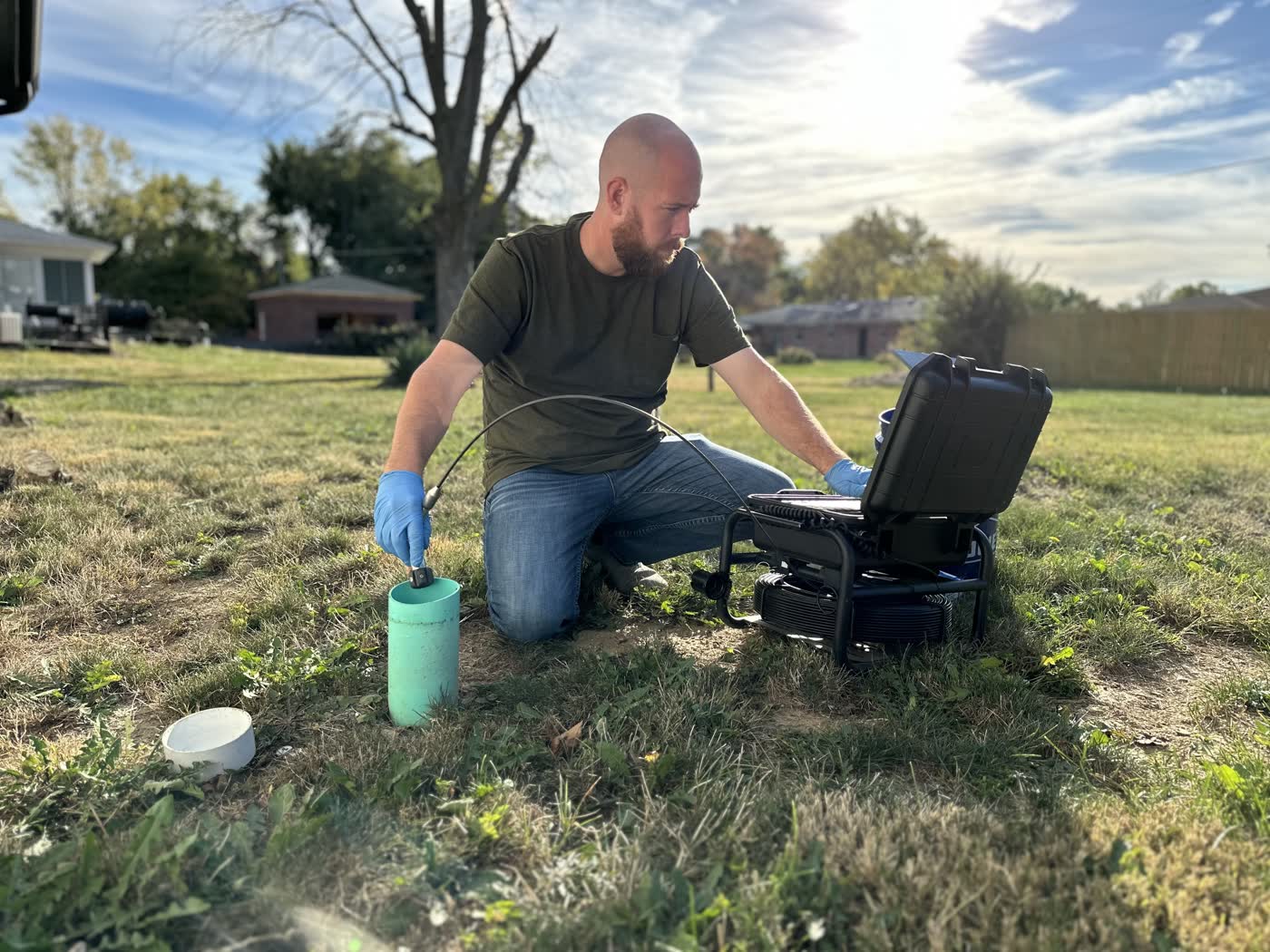
1. Original Aurora vitrified clay tile failure (East Colfax corridor, inside I-225 loop). The pre-1925 Original Aurora housing stock is on original vitrified clay tile laterals in 2-to-4-foot mortared sections. Mortar fails first. Root intrusion through failed mortar joints is the textbook finding. The aggressive Aurora root species are Siberian elm (heavy throughout Original Aurora), cottonwood along Sand Creek and the urban floodplain, Russian olive across the urban fringe, and green ash street plantings throughout. American Society of Civil Engineers identifies root intrusion as a leading cause of sanitary sewer overflow nationally (per ASCE Infrastructure Report Card). Repair runs $1,500 to $5,000 for sectional repair, with full replacement on aggressive root-mass cases pushing $100 to $600.
2. Cast iron scale on 1920s-1970s Aurora stock (Original Aurora, Anschutz-adjacent, Aurora Stapleton). Cast iron was the Aurora standard from the late 1920s through the 1970s. Documented service life is 50 to 75 years (per Cast Iron Soil Pipe Institute), putting nearly every original install at end-of-life. Heavy black scale on the pipe floor narrows the effective diameter from 4-inch nominal to 2 inches or less. Aurora-area descaling runs $200 to $800 depending on length.
3. Orangeburg in the 1948 to 1968 window (Anschutz-adjacent, Aurora Stapleton, mid-century Original Aurora pockets). Orangeburg (bituminous fiber conduit) was used during the post-Fitzsimons-era Aurora buildout. Documented mean failure age is 30 to 50 years (per U.S. EPA pipe materials reference), so every Orangeburg lateral in Aurora is past expected service life. On camera: deformed oval cross-section, blistered interior wall, partial collapse. Repair is full replacement, with Aurora Orangeburg replacement running $4,000 to $15,000 plus Aurora Water permit and connection coordination.
4. Bentonite-driven PVC belly formation (Tower, Saddle Rock, Murphy Creek, post-1990 master-planned). The post-1990 Aurora master-planned communities sit on the same Pierre Shale and Denver Formation as the older neighborhoods. PVC laterals do not crack but do dip and rise as the bentonite-rich soil column shifts. On camera: visible drop-and-rise where the camera tilts down through a low spot. Belly repair runs $1,500 to $4,500 for a single section. The pattern is invisible without a camera, which is why pre-purchase scope on a 1995-2010 Tower home still has value despite the relatively newer construction.
5. Sand Creek alluvial belly formation (eastern Aurora floodplain parcels). Properties immediately along Sand Creek (and its tributaries through eastern Aurora) sit on alluvial soils that compact unevenly over decades. Even PVC laterals develop belly formation in this geology. On camera: tilted-down-tilted-up profile with standing water in the dip. The same pattern documented for South Platte floodplain parcels in Adams and Denver counties.
6. Altitude freeze-thaw cycling (universal to every Aurora address). Aurora sits 5,400 to 5,800 feet across the developed footprint, with the same 90-plus annual freeze-thaw cycles documented for Denver County (per Colorado Climate Center). The combined attack of expansive-soil heaving plus 90-plus freeze-thaw cycles drives Denver-area lateral replacement to $4,000 to $15,000 range versus the $3,956 national average Angi reports (per Angi sewer line cost guide).
One additional Aurora variable: Aurora Water permitting is unified across the entire city, which simplifies repair-permit coordination relative to the fragmented Arapahoe County special-district environment. Aurora Water also publishes a comprehensive online portal for permit history, connection records, and lateral ownership documentation. The city tap is Aurora Water's responsibility; the lateral run from the home to the tap is the homeowner's.
Aurora inspections run on the same platform every Sewer Scope metro uses. Booking by phone at (720) 239-2322 or online. Same-week appointment standard, with Mon-Fri 7a-7p MT · Sat 8a-4p window. The technician arrives in the agreed window, locates the cleanout, runs the camera from access to the Aurora Water city tap with footage marked, and packs out. The report follows in roughly 24 hours, distributed to buyer, agent, plumber, and lender as requested.
Aurora-specific notes: pre-1945 Original Aurora properties frequently have no exterior cleanout, requiring access through a basement toilet or a removed cleanout cap on the interior stack. Tower, Saddle Rock, and Murphy Creek master-planned newer-stock have standard exterior cleanouts and run quickly. We confirm county and ZIP when booking because of the Stapleton namespace ambiguity (Aurora Stapleton vs Denver Central Park, formerly Stapleton).
Aurora is one city across two counties. The vast majority of Aurora (Original Aurora along East Colfax, Aurora central along Mississippi, southeast Aurora toward Saddle Rock and Tower) sits in Arapahoe County. The northern third of Aurora (north of I-70 including parts of Anschutz and Aurora-east Adams) sits in Adams County. Aurora Water serves the entire city regardless of county. The county split matters for jurisdictional records and health-department septic permitting, but not for the lateral inspection itself.
Source: City of AuroraOriginal Aurora is the area along East Colfax between Yosemite and Peoria, plus inside the I-225 loop. Aurora was incorporated 1903 as the town of Fletcher, renamed Aurora 1907. Bulk of original Aurora housing dates 1920 through 1945, with significant 1900-1920 stock near East Colfax. Lateral material is vitrified clay tile in pre-1925 stock, transitioning to first-generation cast iron through 1920s-1940s. Original Aurora is the highest-defect-rate scope area in the city.
Source: City of Aurora historyYes. Aurora has a neighborhood called Stapleton in the city's central residential area along East Colfax (named after a local family, not the airport). This is a different Stapleton from the Central Park / former Stapleton International Airport redevelopment in Denver County. Aurora Stapleton is 1940s-1960s residential. Denver Stapleton is post-2002 PVC redevelopment. Confirm county and ZIP when discussing Stapleton-related work because the defect catalog differs sharply.
Source: City of AuroraThe University of Colorado Anschutz Medical Campus sits at the former Fitzsimons Army Medical Center footprint, redeveloped from the late 1990s onward. Residential neighborhoods immediately surrounding Anschutz (Fitzsimons, Sand Creek, Stapleton-Aurora) are mostly 1950s-1980s ranch and bungalow housing on cast iron and Orangeburg. Anschutz adjacency does not change the lateral material profile of an adjacent home; the 1950s-1980s build year does.
Source: CU Anschutz Medical CampusThe Tower Triangle (south Aurora bounded by Tower Road, E-470, Smoky Hill Road) and Saddle Rock (southeast Aurora) are 1990s onward master-planned residential developments. Lateral material is uniformly schedule-40 PVC. Defect-find rates are lower than older areas, but not low: even newer homes fail a sewer scope about 40% of the time, and the bentonite-driven PVC belly pattern documented across all Pierre Shale Front Range geology still applies. A scope on a 1995-2010 Tower or Saddle Rock home documents the bentonite-belly profile that is invisible without a camera.
Source: City of AuroraYes. Colorado Revised Statutes 38-35.7-102 and the SPD19 disclosure form require the seller to disclose the source of water and sewer service, any known defects, and any history of backups or repairs. DMAR treats pre-listing scope as best practice on any pre-1985 Aurora listing, essentially mandatory on Original Aurora pre-1945 listings because of clay tile and cast iron prevalence. Aurora Water records show service line ownership running from the home to the city tap connection.
Source: Denver Metro Association of REALTORSAurora is the highest-transaction-volume single city in the Front Range for Denver Metro Association of REALTORS (DMAR) members listing through REcolorado MLS (per DMAR and REcolorado). The scope conversation here splits sharply by submarket: Original Aurora pre-1945 listings are essentially mandatory scope candidates because of the clay tile and cast iron prevalence; Anschutz-adjacent 1950s-1980s listings are best-practice because of the cast iron and Orangeburg risk; Tower, Saddle Rock, and Murphy Creek master-planned listings are baseline-documentation scope candidates because of the bentonite-driven PVC belly pattern. Colorado Revised Statutes 38-35.7-102 and the SPD19 disclosure form require sewer-system disclosure. Same professional report and high quality video. Same 24-hour turnaround. Clean handoff.
Aurora west portion lives here. Centennial, Englewood, Cherry Hills also Arapahoe.
Aurora north portion lives here. Westminster, Thornton, Commerce City, Brighton.
Capitol Hill, Park Hill, Berkeley, Wash Park, Central Park (the Denver Stapleton).
Belmar, Green Mountain, Federal Center. 1950s-1980s build dominant.
4 villages, Centennial Water + Sanitation, no muni govt. 1981-2010 PVC.
The Meadows, Founders Village, Crystal Valley, downtown rhyolite-era core.