
Lakewood was incorporated in 1969 as a defensive municipal incorporation against Denver annexation, but the underlying housing stock dates almost entirely from 1950 through 1985. Cast iron dominates the 1950-1970 builds, with significant Orangeburg in the 1955-1968 mid-century pockets. The city sits directly atop some of the most aggressive bentonite-rich Pierre Shale in the metro, producing one of the highest cast-iron shear-failure rates documented on the Front Range. Belmar (the 2004 redevelopment of the former Villa Italia mall) is the post-PVC exception. Bear Creek, Green Mountain, Lakewood Country Club, and the Federal Center corridor all carry their own submarket-specific defect patterns. About 25 minutes on camera identifies which of the four primary submarket profiles applies to a specific Lakewood address.
Lakewood covers roughly 45 square miles immediately west of Denver County. The 2020 census recorded 155,984 residents (per U.S. Census Bureau Lakewood QuickFacts), making it the fifth-largest city in Colorado. The city was incorporated in 1969 to prevent Denver annexation, but the residential housing stock predates incorporation by two decades, dating from 1950 through 1985 across most of the city. The American Community Survey reports the median Lakewood housing unit was built in 1974. Lateral material is cast iron in the 1950-1970 builds, Orangeburg in the 1955-1968 mid-century pockets, and PVC after roughly 1975.
Original Lakewood covers the pre-1969 housing stock concentrated along West Colfax Avenue, Wadsworth Boulevard, and the older neighborhoods around the Lakewood Heritage Center. This stock dates 1950 through 1968 and is dominated by cast iron and Orangeburg laterals. The pre-incorporation Lakewood was platted as small subdivision parcels by multiple developers without coordinated municipal planning, which means lateral installation quality varies significantly from block to block. Some 1950s-1960s blocks have meticulous original install quality; others have shoddy bituminous fiber Orangeburg installations done as cost-saving substitutes.
Belmar is the mixed-use redevelopment of the former Villa Italia mall that opened in 2004 as one of the earliest American mall-to-mixed-use conversion projects. The residential and mixed-use buildings inside Belmar's footprint are all post-2004 PVC laterals throughout, installed under modern Lakewood Public Works standards. The defect-find rate inside Belmar's footprint is the lowest in the city by a wide margin, though even the newest stock fails a sewer scope about 40% of the time, so a scope is still worth it.
Green Mountain covers the western Lakewood neighborhoods on the lower flanks of Green Mountain itself, mostly 1970s-1980s suburban build. The lateral material transitions from cast iron in the earliest 1970s installs to PVC by the late 1970s. The geology here begins to shift from full Pierre Shale toward the decomposed-granite mountain front, which means defect modes also shift from pure expansive-soil heaving toward decomposed-granite drainage and frost-jacking patterns documented in Jefferson County's foothills.
Bear Creek covers the southern Lakewood neighborhoods along the Bear Creek corridor. The housing stock spans 1960s-1980s ranch homes plus newer 1990s infill. The Bear Creek floodplain runs continuous from Morrison through Lakewood to the South Platte, and parcels along the creek sit on alluvial soils that compact unevenly over decades. Even PVC laterals develop belly formation in this geology.
Federal Center covers the area around the Denver Federal Center, the largest concentration of federal government employees outside Washington DC, hosting agencies including USGS, BLM, FEMA Region 8, and the Bureau of Reclamation. The residential neighborhoods immediately surrounding the Federal Center are 1950s-1970s ranch and bungalow housing on cast iron and Orangeburg, supporting government employee demand. Federal Center light rail station drove additional residential redevelopment from 2013 onward.
Lakewood Country Club is the estate neighborhood centered on the country club established in 1908, one of the oldest in the Front Range. The surrounding residential neighborhood holds estate homes dating from the 1920s through 1960s, with significant post-1990 luxury teardown-rebuilds. The older estate homes carry the same cast iron and Orangeburg risk as any pre-1970 Front Range property, with the added complication of mature canopy root systems on lots planted with ornamentals in the 1920s and 1930s. Long lateral runs across manicured grounds (100+ feet) amplify the bentonite-heaving exposure linearly.
Daniels Park views section sits on the southern Lakewood ridge with views toward Daniels Park and the foothills. Mostly 1970s-1990s build on PVC. The ridge geology is the most aggressive bentonite-rich Pierre Shale exposure documented for the city (per Colorado Geological Survey), which means even PVC laterals show aggressive bentonite-driven belly formation patterns on this stock.
Soil across Lakewood is mapped predominantly as Pierre Shale with very heavy bentonite content (per Colorado Geological Survey). The Daniels Park ridge, the Lakewood Country Club area, and the original Lakewood neighborhoods along Wadsworth all sit on the worst expansive-soil exposure in the metro. The Green Mountain western flank begins transitioning into Pikes Peak Granite and decomposed-granite mountain-front geology, but most of the city footprint is full Pierre Shale.
1. Bentonite-driven cast iron shear failure (the dominant Lakewood finding). Lakewood's heavy bentonite Pierre Shale exposure produces among the most aggressive expansive-soil heaving in the metro. The wetting-drying cycle drives differential ground movement that fractures cast iron laterals in shear faster than in other Front Range cities. On camera in pre-1975 Lakewood cast iron: shear-cracked sections with visible displacement, often at multiple points along a single run. Repair runs $1,500 to $5,000 for sectional replacement, with full-run replacement on long Lakewood Country Club estate laterals pushing $1,500 to $5,000.
2. Cast iron scale (every pre-1980 Lakewood build). Cast iron dominated the 1950-1975 Lakewood building boom. Documented service life is 50 to 75 years (per Cast Iron Soil Pipe Institute), putting nearly every original install at or past end-of-life. Heavy black scale buildup narrows the effective diameter from 4-inch nominal to 2 inches or less. Lakewood-area descaling runs $200 to $800 depending on length and access.
3. Orangeburg in mid-century original Lakewood (1955 to 1968 window). Orangeburg was widely used as a cost-saving substitute during the original-Lakewood building boom. Documented mean failure age is 30 to 50 years (per U.S. EPA pipe materials reference), so every Orangeburg lateral in Lakewood is past expected service life. On camera: deformed oval cross-section, blistered interior wall, partial collapse. Repair is full replacement, with Lakewood Orangeburg replacement running $4,000 to $15,000 plus the Consolidated Mutual or Northwest Lakewood Sanitation District permit.
4. Bear Creek alluvial belly formation. Properties along the Bear Creek corridor (Bear Creek Lake Park area, parts of Green Mountain south, the South Lakewood floodplain) sit on alluvial soils that compact unevenly. Even PVC laterals develop belly formation in this geology. On camera: tilted-down-tilted-up profile with standing water in the dip. Belly repair runs $1,500 to $4,500 for a single section.
5. Lakewood Country Club long-run lateral failure. The 1920s-1960s estate properties surrounding Lakewood Country Club commonly have 100-to-200-foot lateral runs to the city main. Long runs amplify the bentonite-heaving problem because more linear feet of pipe is exposed to differential soil movement. Lakewood Country Club scopes commonly show three or four step-offsets at clay-tile or cast-iron joints along a single run. The aggressive Lakewood-area root species (Siberian elm, cottonwood along Bear Creek, Russian olive across the older neighborhoods, honeylocust street plantings) add root intrusion at the failing joints. Long-run rehabilitation runs $1,500 to $4,000.
6. Daniels Park ridge bentonite PVC belly (post-1975 Lakewood stock). Even post-1975 PVC laterals on the Daniels Park ridge show aggressive bentonite-driven belly formation because of the extreme expansive-soil exposure documented for that ridge by the Colorado Geological Survey. On camera: visible drop-and-rise where the camera tilts down through a low spot. Belly repair runs $1,500 to $4,500 per section; multi-belly runs push $1,500 to $4,500.
One additional Lakewood variable: the city does not operate its own municipal water or wastewater utility. Consolidated Mutual Water and Northwest Lakewood Sanitation District are the two main authorities, with Denver Water providing drinking water to some Lakewood properties under wholesale agreements. The split jurisdiction means permit windows and connection fees vary by district. Verify your specific district before any lateral repair work because the absence of a unified city utility makes Lakewood structurally different from neighboring Denver, Aurora, and Wheat Ridge.
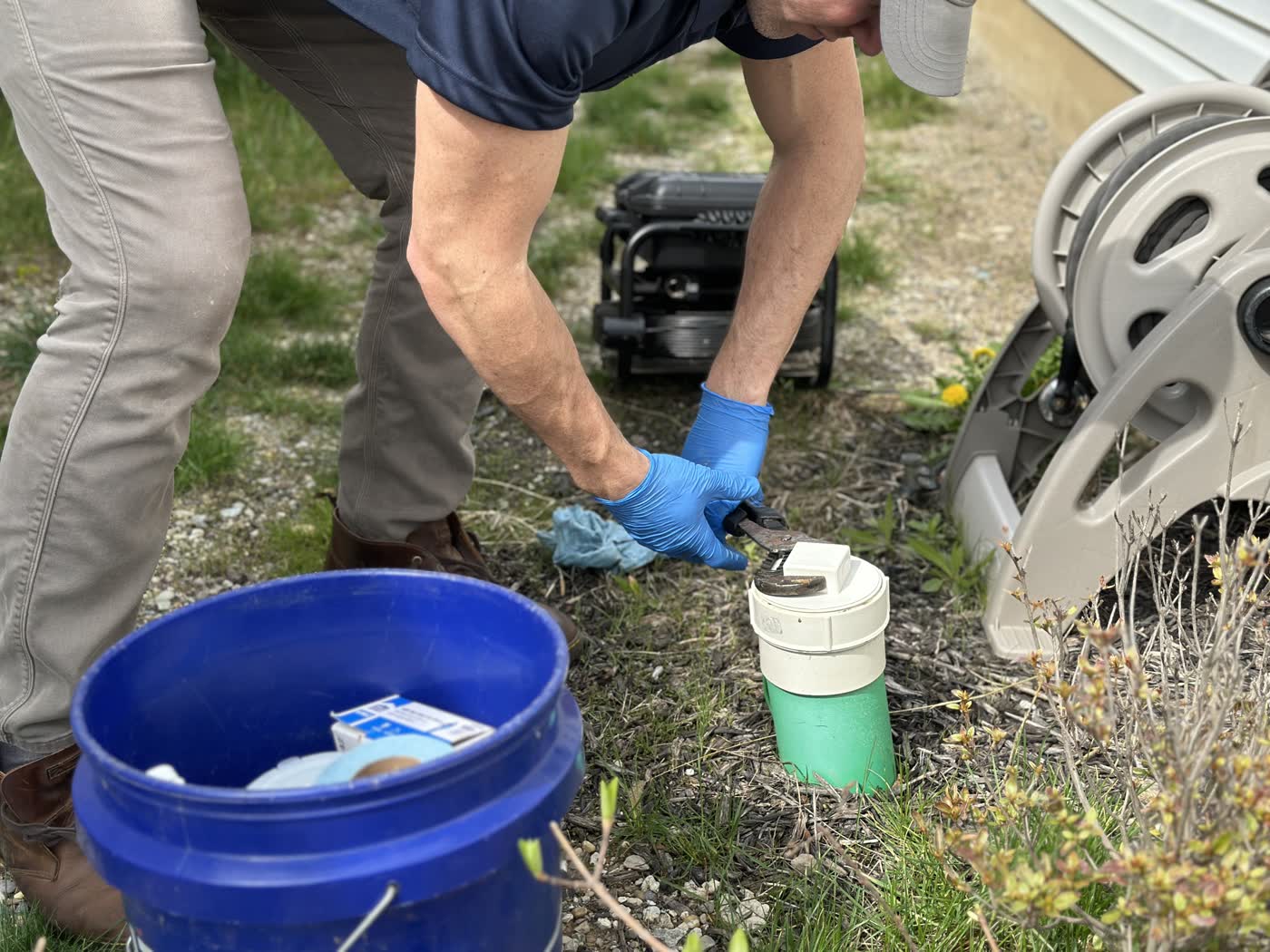
Lakewood inspections run on the same platform every Sewer Scope metro uses. Booking by phone at (720) 239-2322 or online. Same-week appointment standard, with Mon-Fri 7a-7p MT · Sat 8a-4p window. The technician arrives in the agreed window, locates the cleanout, runs the camera from access to the district city tap with footage marked, and packs out. The report follows in roughly 24 hours, distributed to buyer, agent, plumber, and lender as requested.
Lakewood-specific notes: pre-1960 original Lakewood properties may have non-standard cleanout locations because of the uncoordinated pre-incorporation subdivision platting. We confirm access during booking. Lakewood Country Club estate laterals frequently require the camera at full extension because of long-run lengths; we carry the equipment for it. Belmar mixed-use buildings have modern cleanouts.
Lakewood sits directly atop bentonite-rich Pierre Shale that defines the Front Range expansive-soil problem. The Colorado Geological Survey documents the Lakewood area as one of the most aggressive expansive-soil zones in the entire Denver metro. Lakewood Country Club and the Daniels Park view corridor sit on shallow Pierre Shale where the bentonite-driven swell-shrink cycle is most severe. Combined with the 1950s-1980s cast iron lateral material that dominates the city's housing stock, this produces some of the highest cast-iron-shear-failure rates in the metro.
Source: Colorado Geological SurveyBelmar is the mixed-use redevelopment of the former Villa Italia mall that opened 2004 as one of the earliest American mall-to-mixed-use conversion projects. Residential and mixed-use buildings inside Belmar's footprint are all post-2004 PVC laterals installed under modern Lakewood Public Works standards. Defect-find rate inside Belmar's footprint is the lowest in the city, though even the newest stock fails a sewer scope about 40% of the time, so a scope is still worth it. The Belmar Park surrounding the development is older housing from 1960s-1970s with standard Lakewood cast iron and Orangeburg risk.
Source: City of LakewoodService is split across utilities. Consolidated Mutual Water serves the largest share of Lakewood plus parts of Wheat Ridge. Northwest Lakewood Sanitation District covers other sections. Denver Water provides drinking water to some Lakewood properties under wholesale agreements. The City of Lakewood does not operate a municipal water or wastewater utility, which makes Lakewood structurally different from neighboring Denver, Aurora, and Wheat Ridge. Verify your specific district before any lateral repair work.
Source: Consolidated Mutual WaterOriginal Lakewood covers pre-1969 stock concentrated along West Colfax, Wadsworth, and the older neighborhoods around the Lakewood Heritage Center. This stock dates 1950 through 1968 and is dominated by cast iron and Orangeburg. Green Mountain (west Lakewood toward the foothills) is mostly 1970s-1980s suburban with cast iron transitioning to PVC. Bear Creek (south Lakewood) holds 1960s-1980s ranch homes plus newer 1990s infill. Each submarket has its own defect profile.
Source: City of LakewoodYes. Lakewood Country Club is one of the oldest country clubs in the Front Range, established 1908. The surrounding residential neighborhood holds estate homes dating from the 1920s through 1960s, with significant post-1990 luxury teardown-rebuilds. The older estate homes carry the same cast iron and Orangeburg risk as any pre-1970 Front Range property, with mature canopy root systems on lots planted in the 1920s. Long lateral runs (100+ feet) across manicured grounds amplify the bentonite-heaving exposure linearly.
Source: Lakewood Country ClubYes. Colorado Revised Statutes 38-35.7-102 and the SPD19 disclosure form require the seller to disclose the source of water and sewer service, any known defects, and any history of backups or repairs. DMAR treats pre-listing scope as best practice on any pre-1985 Lakewood listing, essentially mandatory on Lakewood Country Club estate listings because of the long-run cast iron exposure. Consolidated Mutual Water and Northwest Lakewood Sanitation District both publish service line ownership documentation.
Source: Denver Metro Association of REALTORSLakewood is one of the highest-defect-rate buyer markets in the Front Range because of the heavy Pierre Shale geology combined with 1950s-1980s cast iron lateral stock for Denver Metro Association of REALTORS (DMAR) members listing through REcolorado MLS (per DMAR and REcolorado). The scope conversation here is straightforward: on any pre-1985 Lakewood listing, a scope is essentially mandatory due diligence; on Lakewood Country Club estate listings, scope plus long-run camera capability is required because of the 100+ foot lateral runs. Colorado Revised Statutes 38-35.7-102 and the SPD19 disclosure form require sewer-system disclosure. Same professional report and high quality video. Same 24-hour turnaround. Clean handoff with no repair upsell.
Lakewood sits in Jefferson. Wheat Ridge, Golden, Arvada, Evergreen also Jefferson.
Capitol Hill, Park Hill, Berkeley, Wash Park, Stapleton. Full century build spread.
Aurora west, Centennial, Englewood, Cherry Hills. Mostly 1960s-1990s suburban.
Westminster, Thornton, Northglenn, Commerce City. Industrial Commerce legacy.
Arapahoe + Adams split. Original Aurora 1920s clay, Tower 1990s+ PVC.
Boulder, Longmont, Louisville, Lafayette. CU late-1880s housing near campus.